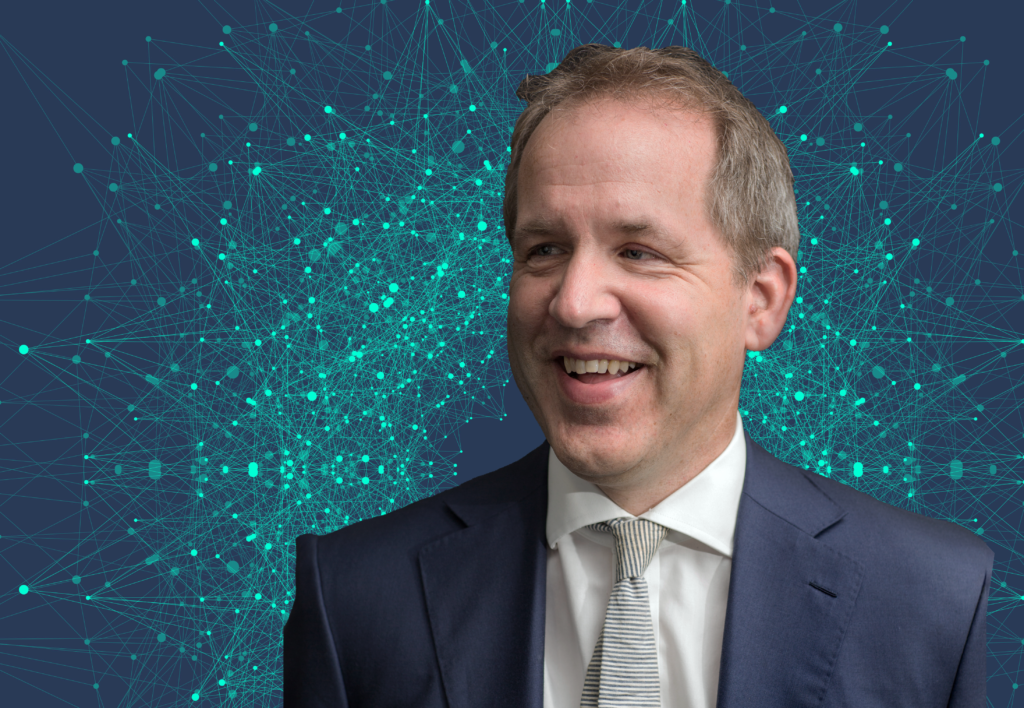
As Professor Duncan Ivison embarks on his first semester as President and Vice-Chancellor at the University of Manchester, we were delighted to have the chance to talk to him and hear his ambitions and areas of focus. His global experience is clear and particularly within large, complex institutions, and he sets this in the context of his plans for Manchester so well throughout this interview. But what is very clear from him is the importance in his mind of the history, the community and the opportunity for the institution and the city.
The political environment is also very relevant in the timing of this conversation, but also reflective of the change in government in Australia where he has come from. Manchester is an institution of remarkable standing, and while maintaining the first-rate reputation and position left by former VC Nancy Rothwell, there is a tangible sense of evolution from Duncan, informed by his global, commercial and co-collaboration experience; we were so grateful that he was willing to share this so openly and honestly.
Duncan, congratulations on your appointment at the University of Manchester. Your international background and career, latterly as Deputy VC at the of Sydney and previously with also the University of Toronto offers a new perspective. How do you believe this will shape your approach and ambitions for Manchester?
Thanks very much! The University of Manchester occupies a unique position, not just in the higher education sector in the UK, but globally. The connection to the city and its history here is just extraordinary, particularly as the world’s first civic university, and this is increasingly important in today’s world where these institutions are so crucial to the flourishing of cities and communities, and increasingly central to the ambitions of government.
I see my international experience in Canada and Australia – and of course the UK – as bringing a global perspective to Manchester, and equally taking Manchester to the world. Nancy and her team have done an amazing job before me, but I do believe there is an opportunity to let more of the world know about this institution and the city through more global engagement.
We need to be clear about our global perspective over the next decade and I believe my experience will help shape that. We can learn from things that have both worked and not worked in Sydney and elsewhere. Part of that is ensuring that Manchester aspires to be seen globally as a high-quality education and research-intensive institution, but also very much a socially engaged and place-based university. The model that Manchester has been developing is powerful, and I want to bring more global awareness to that.
We have an international community already, with our researchers, teachers and students coming from all over the world, so we are automatically involved in lots of global conversation around our disciplines, our students and our alumni.
It’s also important that, at a time when states are becoming more narrowly focused on issues of migration and security, universities need to be those institutions that are always looking outwards beyond borders and trying to make connections rather than shut them down. I think we have a moral responsibility to always be looking to connect.
“Australian institutions and their leadership have developed a more strategic edge, and that is an important factor in why many Australian university leaders have been sought out by other institutions.”
Are there comparisons you can make between leadership approaches in higher education between Australia and the UK? Or equally, differences to note?
There is a great deal of policy interchange between the sectors in Australia and the UK and common interests certainly. The Australian Government recently undertook a major review of higher education and some of the findings from that are of interest for the UK, and discussions are under way in that context. There have been examples of where an Australian policy shift has influenced the approach in the UK (and vice versa). The establishment of the contingent loan system, for example, which was initiated in Australia, subsequently shaped, in part, on what was introduced in the UK. And Australia also introduced a research assessment process (Excellence in Research in Australia), modelled, at least in part, on the UK’s Research Excellence Framework (REF). Although it has recently been dropped.
However, one of the differences I would note is that Australian universities must hustle a bit harder to generate resources. That’s not to say that UK institutions don’t have to work hard in challenging funding conditions, but in Australia, there is much less government support for research, in particular.
As a result, I think Australian institutions and their leadership have developed a more strategic edge, and that is an important factor in why many Australian university leaders have been sought out by other institutions globally, including in the UK. The leadership culture in Australian higher education is probably more ‘top down’ in orientation, and this has worked well for some things, particularly in improving research performance.
There is currently a number of UK-based VCs with experience of Australian higher education (e.g. Kings College London, UCL, Aston, and now Manchester). Why do you think this pipeline of talent is so strong, and what makes leaders in Australian institutions so successful in securing top roles in the UK?
I have some personal observations about this! First, I think Australian higher education has been relentlessly globally oriented for a long time. It has had to be to attract the best students and the best faculty to its institutions, and that is challenging given its geographic location and distance from the UK and US, especially. As a result, the research-intensive institutions in Australia have developed a strong focus on their competitive position and what they need to do to succeed.
Second, there is a lot of similarity between the two sectors, even though there are important contextual and cultural differences. For example, as I mentioned above, there is a lot of policy cross-over between the countries, and now, in Australia there is a relatively new Labour government, and also now a new Labour government in the UK, with a lot of interaction between them and thus a lot of networks that UK and Australian academic leaders and academics share as a result.
And finally, Australia has a concentration of research-intensive universities that are large by global standards, with complex organisational cultures and stakeholder engagement requirements, and there’s a limited pool of people globally who have led institutions like that. Many of the Australian institutions that recent VC appointments in the UK have come from are multi-billion-dollar organisations, with 60,000+ students, for example.
I believe these are some of the reasons why larger UK universities are interested in what Australian leaders have done and want to learn from that. Having said that, the UK is also the source of some extraordinary university leaders!
As we enter a period of political change, is there more that you believe can be done to help address challenges in the sector over the next 5-10 years? How do you anticipate addressing this in your role?
There’s a huge opportunity here, the focus on city and regional government is an important one for Manchester. We have a deep and meaningful partnership with our city and regional governments and organisations, more so than in any other institution I have ever worked at, and that’s been an absolute joy to engage with. I also think that despite all the challenges, there has been a consistent investment in science and innovation in the UK in a way that we just didn’t have in Australia, and that can be built on as well.
The sector, especially amongst the larger research-intensive universities, has so much to contribute to the national economy and society. Working in partnership is key: whether with our students, staff, alumni, governments, community organisations and industry and demonstrating how we can contribute to the ambition of delivering genuinely inclusive growth will be critical.
Manchester, and the north-west more broadly, is an innovation powerhouse, nationally and globally. We need to demonstrate to the government how we can work together in areas such as skills, innovation, and better access to higher education to drive genuinely inclusive economic growth.
Previous governments have got caught up in culture wars with universities and while some of those issues will probably remain, the tonal change the new government has signalled is important and an opportunity to position our institutions and sector as problem solvers – rather than problems themselves – who are here to collaborate for the national interest.
“We can do much more in common by working together, co-investing in infrastructure, in multidisciplinary research and in teaching initiatives. This is something I really tried to drive in Sydney, and I want to do this in Manchester too.”
A progressive new partnership between the innovation clusters in Cambridge and Manchester was announced at the end of 2023. What do you believe the opportunities are for this and how much emphasis will this have in the future direction of Manchester’s research and development aims?
This is a hugely exciting one for me. I am a big believer in universities working more closely together. It’s something I did a lot of in Sydney, vis a vis our industry and government partners. In the past, universities have been hyper-competitive with each other. We’ll always compete on some levels – for example, for students and to attract the best staff. But I think we can do much more in common by working together, co-investing in infrastructure, in multidisciplinary research and in teaching initiatives. This is something I really tried to drive in Sydney, and I want to do this in Manchester too.
There is already a great relationship between the universities within the city of Manchester, but I’d really like to see that across the north and nationally as well, beyond what the Russell Group and Universities UK already do. If we can develop coalitions and consortia of universities who agree to work together around specific initiatives, this would be a very powerful way for governments, industry and communities to engage with us.
Our emerging relationship with Cambridge, for example, is exciting, and there are collaborative opportunities where we have complementary strengths in innovation, science, and creative and cultural domains. There are also opportunities where we can help each other from a city perspective. Cambridge doesn’t have enough space for all the companies it is spinning out, and we have an ambitious innovation agenda and room to grow.
The growth agenda is so important, and Manchester wants to attract the same level of inward investment that is happening in other parts of the country, and I think building relationships with other universities both in the north and the south will help to lift the economic performance of the regions and create amazing opportunities for our staff, students, and our partners. It’s a big part of my agenda in this role and I really want to build and invest in those relationships.
The leadership profile of a Vice-Chancellor has arguably evolved in recent years, and perhaps at an accelerated pace since the pandemic. What, in your view, are the most critical attributes needed to be a successful leader in higher education today?
I see the university as a gloriously complex ecosystem and the role of the Vice-Chancellor is to care for and support that ecosystem; to repair broken links that have come under stress, and to think about its future sustainability, and all the while being super clear about the strategic intent of the institution.
One thing I’ve learned over the years is that my university colleagues really care about the strategic direction of the institution. They want to feel they’re part of something that is true to its mission but is also ambitious for the future. The VCs I have really learned from have a deep love of the institution they are part of, but also, and at the same time, they’re always looking to the future and challenging the organisation to get better. We’re asking fundamental questions about the nature of the world, educating the next generation of students, and contributing to the flourishing of the communities we serve. We are also engaging with literally thousands of stakeholders in a very complex regulatory and political environment
It is an extraordinary job and we’re all trying to take a long-term view, which is challenging in a very short-term obsessed political and regulatory environment. Days and weeks are often dominated by short-term reactive activity, but VCs cannot lose sight of that long term vision. The institution will be here long after we’re gone, and as VC, your role is to think strategically about its future and to ensure it continues to flourish. In a resource constrained environment, that often means making tough choices, but also bringing the community along with you and explaining why they need to be made.
“You need to ensure that the appropriate balance is always being struck between the different parts of the communities we serve. They need to challenge you, but at the same time, be among the institution’s greatest advocates.”
The relationship between the VC and senior team with the Board of Governors is an important one, but does it need to evolve in your view to meet the institution’s ambitions and also sectoral evolution?
As universities become more and more porous and turn themselves outwards in everything they do, a governance structure which reflects, supports and challenges the leadership team is important. We need experience from different parts of the community on our boards.
Reflecting on Australian higher education over the past decade, many of the boards of the eight research-led institutions have significantly increased their membership from industry and business backgrounds, and that’s been incredibly valuable. I learned so much from members of Sydney’s Senate (their Board of Governors), for example, who had extensive experience running large infrastructure projects in the private sector with complex stakeholder challenges. On the other hand, there also have to be members who come from the non-profit sector and other communities we serve, as well as appropriate representation from students and staff, to make sure that we are always being challenged to improve our support for them.
There is always a risk that if your board drifts too far away from grasping the complex but core mission of a university, then it can create a disjuncture between the board and the university community. That puts the Vice-Chancellor in a very difficult situation. You need to ensure that the appropriate balance is always being struck between the different parts of the communities we serve. They need to challenge you, but at the same time, be among the institution’s greatest advocates.
Professor Duncan Ivison – Biography
Professor Duncan Ivison, FAHA FRSN, is President and Vice-Chancellor of The University of Manchester. He holds degrees from McGill University and the London School of Economics. With over 20 years at the University of Sydney, Duncan has extensive experience in academic leadership, including roles as Dean and Deputy Vice-Chancellor. A distinguished political and moral philosopher, he’s received numerous awards and held visiting positions at prestigious institutions worldwide. Duncan is passionate about public engagement and building partnerships between universities, communities, industry, and governments.