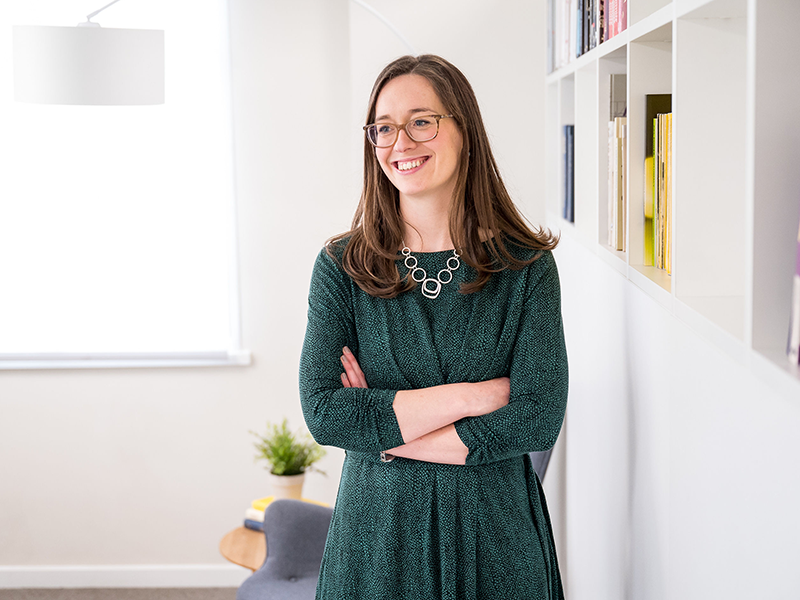
We are delighted to introduce Kat Mason who has stepped into the role of Social Impact practice group head, taking the reins from Rachel Hubbard as she transitions into a more board search-focused role. Formerly Chief Executive at MediCinema, Kat will play a vital part in growing our knowledge and experience of the sector and further developing our work with social impact organisations.
Can you tell us a bit about your career prior to coming to Saxton Bampfylde and what attracted you to join the firm?
Having spent 16 years supporting mission-driven organisations in the not for profit sector, the final 10 as CEO, I have seen first hand the transformative value of high quality leadership in positioning organisations to best deliver their mission and grow their impact to make the difference they need to in society – and that is my driving passion.
I joined the charity sector straight out of university. After graduating with a degree in history and a dissertation on the challenges of running a large multi-national NGO in India and Pakistan, I landed in a very small organisation which was working to meet the needs of its beneficiary group on the ground. It was a huge learning curve as I was one of just three team members and within a month of me joining, my Exec Director had a stroke. Aged 22, I was completely thrown in at the deep end and found myself running this small charity. It was fascinating, and made it so clear to me how challenging it is to run an organisation when you don’t have the background, experience or skills required. You might have passion for helping like I did, or know exactly how to do social care, or work with teenage offenders, but you probably don’t know how to build a marketing plan, run the finances or plan for sustainability!
After that, my career focused on helping organisations to increase their impact, both in frontline organisations in health and mental health and an infrastructure organisation. I spent three years supporting charities and social enterprises across the sector at a charity called Pilotlight, which helps charities grow their impact by connecting senior business leaders in teams with with charity leaders to coach them through the process of organisational strategic business planning. I loved working across the sector, supporting leaders and learning from the business leaders – it was much like doing an on the job mini MBA. I then stepped back into directly helping people and worked for three years with a mental health charity. That was the point at which I met Saxton Bampfylde who placed me into the role of CEO at Medical Aid Films, a small charity using technology and film to support healthcare workers in low-resource settings with medical education. When I took it on, it was really a kitchen table kind of size, and I worked with the team and the trustees to build that into something that had real backbone behind it adding value through content and partnerships to the brilliant organisations working on the ground.
“Saxton Bampfylde brings together my interest in organisations and my passion for people.”
From there, I moved to MediCinema, a health and arts charity which uses films and the shared cinema experience to improve the wellbeing and quality of life of patients in hospitals. Working with and between the health sector and the film and cinema industry for the benefit of patients and their families was hugely rewarding. Again, my role was to take an organisation that had good bones and a strong idea, and grow it into something able to make a real impact but that was also financially sustainable and with well-established partnerships. Doing that, setting the charity up for growth, building a fantastic team, quadrupling our annual impact and reaching over 174,000 patients during my time there are the things I am most proud of.
Saxton Bampfylde brings together my passion for supporting a vibrant social impact sector, my interest in organisations and how to support them to achieve the most for their beneficiaries, and my love for and interest in people. I’m fascinated by the question of how you become a good leader and how you bring the right people with the right skills, experience and values into the right organisations? Because the right leader in one organisation of course isn’t the right leader in another or at a different time. It’s about really getting under the skin of an organisation and its people, and the amazing talent and leaders in the sector and from others, and making the right connections.
You spent your last year and a half as CEO of MediCinema working in the midst of a global pandemic. What measures did you put in place to ensure your team continued to feel connected?
It was a huge challenge, and something really alien. Everybody was experiencing this complete upheaval, both in practical and emotional terms. The challenge for MediCinema, which was mirrored in a lot of organisations, was that we had to close our services even before lockdown was imposed. We suddenly had part of the team working well above full time to pivot services and make sure we could continue to be there for our beneficiaries and that financially we would be able to weather the storm. And then then we had the cinema managers, for example, who were immediately put on furlough once that became an option. We also had some people who were partially furloughed.
We had this combination of people who were working at the speed of light and juggling all sorts of priorities, balanced against people who desperately wanted to work but couldn’t. There wasn’t one solution, it was a variety of things, and what we did changed at different times. At the beginning, we were doing two weekly hour and a half meetings of the core team because the pace of change was so fast. At the start of those, I’d always give an update on what was happening in the world and what it meant for us to ensure nobody felt cut off or unsure about our direction. At the beginning of each of these meetings, I always included an agenda point for coffee. This was a half hour of just chat about life and what people were finding hard or fun or challenging. We shared TV recommendations and ideas for activities that had made people feel better or more connected.
I also started communicating much more regularly on email – possibly over communicating even! It felt so important not just for the team that was working, but also for the trustees and for the team that was off. Even though they weren’t working, I wanted them to know what was going on as things were just moving so quickly.
MediCinema obviously sits between healthcare, the film industry and the charity sector, so there were a lot of moving parts to keep track of to ensure we knew what each update meant for everybody. One of the things we did quite quickly was to introduce monthly ‘reflection meetings’, which were like team therapy! Nothing work related, just a real check in on what we were feeling, how we were communicating with each other.
We quite quickly realised that there were some people who were on meetings all the time, and others who really never needed to communicate with others to do their job. It was funny – we realised we’d forgotten how to use the phone and to communicate ad hoc, because it had all become so structured when you had to set up a video call. I made sure I was connecting directly with anyone who might be sat just at home with their computer.
We also tried lots of social things, always including those who were on furlough, and what we landed on that worked really well for my team was a cook-along! We’d all get together and someone would put forward a recipe for us all to cook together. We had teams based all over the country and some abroad, so it actually worked as a really nice leveller, bringing everyone together.
What lessons have you taken away from your experience leading a charity through such an unparalleled time?
The key lesson for me is that the sector – and the leaders and people within it – is incredibly resilient. More so than I think a lot would think. My experience of organisations within the voluntary sector that work well is that, because they are there to meet a very specific need, you can guarantee that relatively quickly they will find a way to get in and act to meet that need. COVID really showed that: mission-driven organisations recognised that the people we were supporting had a heightened need and the delivery method had to change overnight. So it just did!
The flip side to that is that across a lot of the voluntary sector – and for healthcare too – burnout has become a real issue. There was a need to move at a million miles an hour to support the people in need of our services, but at some point you have to turn that into something more sustainable. Holidays, breaks, boundaries, exercise: the balance has to be there. They’re not things I didn’t know before, but COVID has definitely crystallised my thinking.
“Mission-driven organisations recognised that the people we were supporting had a heightened need and the delivery method had to change overnight.”
What are the key challenges you anticipate charities will face as they look to re-establish and develop services post-pandemic?
The social impact sector is so vast and encompasses so many different organisations working in so many different spaces and at different scales that there are impacts that have been felt across the board and others that are very specific. Some organisations have really thrived, where others have faced more of a struggle; but all of us are dealing with uncertainty and multiple transitions, all of which need us to be hugely adaptable and resilient as leaders and people.
Each organisation’s set of challenges is naturally going to be specific to them, however across the board we are seeing increasing need thanks to both the economic and health impacts of COVID. The tail of COVID is going to be really long and will encompass both health inequalities and economic inequalities. Stepping up to meet that increasing need is going to be the key theme as charities look to move forwards.
Alongside that will be funding and ensuring financial sustainability. Whole funding models have changed, sources have dried up, new ones are emerging. Organisations that can be nimble, innovative, and forward-thinking about their income streams are the ones that will come out stronger.
The third area of challenge will be people. There is huge value in the people who work in the sector, they are passionate and committed and go over and above: especially in the last 24 months. However they are exhausted from continual change and stepping up to the challenges of the pandemic, both professional and personal. Leaders need to bring the balance back for their teams and really look after them and make sure wellbeing is there. It needs to be proactive pastoral care. We lean on our people a lot, especially when funding is tight and the need is high: that will always be there in a sector that is driven by mission, but it needs to be tempered and balanced against looking after our people.
“The tail of COVID is going to be really long and will encompass both health inequalities and economic inequalities.”
What are your top line ambitions for Saxton Bampfylde’s Social Impact practice as you move forward?
The big thing for me is that the practice already does what it does incredibly well, but I think our aim now needs to be to do that even better and bigger for our clients, and deepen both our individual relationship as well as our partnership with the sector as trusted advisors on leadership. The search part – finding the right leaders at the right time – is of course a big part of what we do, but it’s broader than that. It’s about supporting organisations for the long term on their senior level issues, whether that be the board, Chief Executive/Chair relationships, convening and connecting leaders to share experience, expertise and knowledge, leadership roles, to proactively supporting the next generation of diverse leaders, and so on.
Having sat on the other side of Saxton Bampfylde, I have seen the true value of this in transitioning Chair roles and building a high functioning board for growth. And one of the things that the firm does uniquely well and the value of which we want to real dial up for our clients and candidates is truly working across sectors and practice groups. It goes without saying that every social impact organisation touches other sectors. You can’t be a social impact organisation and sit in a silo. The value that Saxton Bampfylde brings is in understanding these sectors and their networks, enabling out of the box thinking, broadening horizons and helping clients to think more about organisational problems in the round rather than in the light of a particular sector.
Over the course of your career, you have been a Saxton Bampfylde candidate, client and now consultant. What insights do you think this will allow you to bring to your role?
I think it’s really important to understand the pressures a client is facing – timewise, people-wise, reporting-wise – and really consider where Saxton Bampfylde can add value. Having seen the other side, I hope this will help me deliver a greater depth of awareness of that right from the start. That will help me bring forward a way of working that is exactly suited to the needs of each client.
Client and candidate care are at the heart of what Saxton Bampfylde does, but the journey for a candidate can be tricky. You have times where you’re wobbly and thinks might not go in a linear way. Having sat as a candidate, I have an understanding of what that process looks like from the other side and the emotional aspect of it as well as the practical or process-driven aspect.
Do you see digital transformation more as a challenge or an opportunity for charitable organisations? What can leaders do to ensure the transition is as smooth as possible?
Digital transformation is a huge driver for change in the social impact sector. It has huge opportunity for the sector, but it is also a challenge. As with any change management piece, it all comes back to focusing on what the reason is for the change. Leaders must clearly envision the impact of digital transformation and what that means for their organisation in a way that is both aspiration and visionary, while also being tangible. They have to consider both how digital can enable delivery of the overall mission alongside what it means for their team’s day-to-day jobs.
Getting the right skills around the table is crucial here. It’s impossible to deliver in an area like digital if you don’t know what your options are! That has to be led right from the top down: boards need at least one person who understands digital, has it part of their remit and is thinking consciously about it. Digital also needs to be embedded in all workflows at all levels of an organisation: it must go beyond just working remotely or providing services remotely.
What can be done to ensure that the talent pool in the social impact sector is as diverse and representative of the communities it serves as possible?
Lived experience – the beneficiaries that the organisation is working with and for – have to be at the heart of everything that is done including feeding back and planning for the future. There are many ways of achieving this within an organisation, but having that as an ethos is crucial. Charities don’t exist to help and save others, they must work with and support their beneficiaries.
I always think that with charities your aim – if you can get to it – is to become defunct! You want to have done your job so well that it is no longer required. Ideally, you want to end up obsolete. Most organisations won’t get anywhere near that in their lifetime, but it’s a journey towards that goal. Diversity is hugely important to achieve that. At Saxton Bampfylde we recognise the need for future leaders to be supported to enable this, and that is why the STEP and REACH programmes we have set up and run to proactively play a part in that journey are so important.
Can you share a lockdown learning with us?
I had an interesting set of lockdowns, having only come back from maternity leave with my second child a few weeks before the first national lockdown was announced! Letting go was a big thing for me, that and the fact that you can fit a lot into a day if you have to! Juggling childcare with work and family life was a real balance. The key thing that got me and my husband through was working as a team and establishing clear boundaries, delineating between work time and leisure time. It was helpful that everyone was in the same position, so we were all cognisant of each other’s situations.
My children were 9 months and just under 4 when we went into lockdown, so they weren’t really aware of what was going on externally. The beauty of that was that I got chance to really connect with my inner child and leave all the doom scrolling behind. It was really good to get some proper family time together.
What is your favourite way to destress or take time away from work?
Back in January, I did a half marathon in aid of MediCinema, and while the timing wasn’t great – I ended up having to do my training in the depths of winter, going for runs at 6am with a headtorch – it became my time in a house where I had no time or space. It was my zen time, the time I’d carved out for myself.
Where I live is in a town, but close to the countryside. One of my key runs is along the canal and you see herons and swans as you go along. Or I’ll go through the woods and get to see birds of prey and all sorts of wildlife there Connecting with nature is really key for me.
If you could spend 24 hours in any city in the world, where would you go, and how would you spend the time?
I love travelling and grew up all over the world. We moved every three years when I was a child and it’s left a real love of travel in me and certainly made me the person I am today. If I could go anywhere at all right now I think I’d go somewhere like Istanbul. Somewhere I’ve not been before, which has a hugely rich cultural history. It’s a place that for me represents a real coming together of lots of different cultures, and I think I’d just want to walk around the streets, pop into mosques and churches, travel along the river and explore the food. I’ve always wanted to go, and I’d love to just wander the streets without too much of a plan.