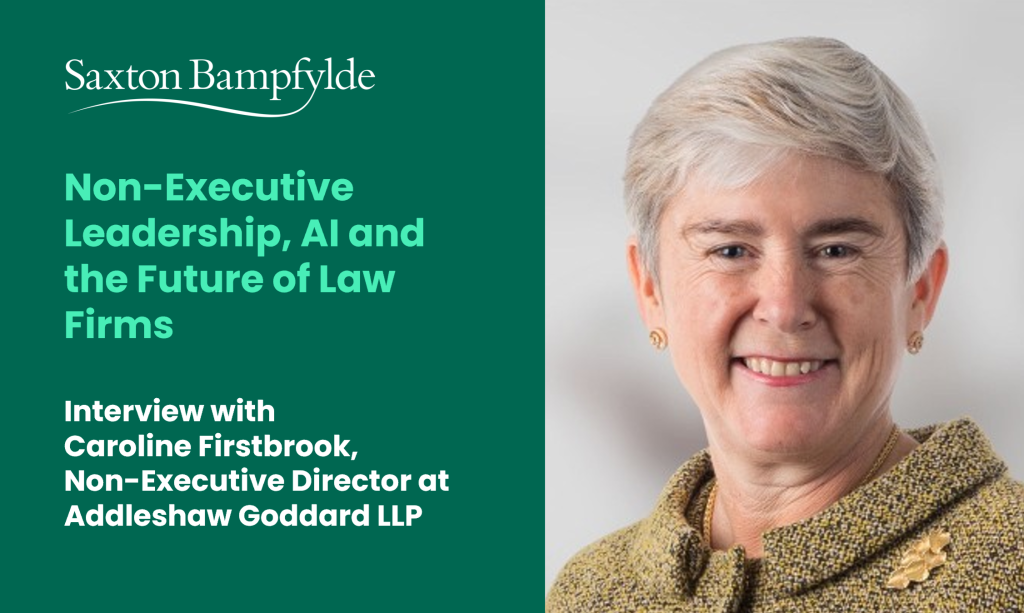
Caroline Firstbrook, Non-Executive Director at Addleshaw Goddard LLP, spoke to Kate Ludlow and Mary Few on her reflections on governance, professional management and what will differentiate successful law firms in an era of accelerating change.
From Professional Services to the law firm Boardroom
Caroline has spent her career in large, complex professional services organisations, from Monitor and Accenture, to running her own consultancy, and most notably seven years as Chief Operating Officer at Clifford Chance. That breadth of experience is precisely what drew her to a non-executive director role in a law firm.
“I feel I bring a lot to any professional services organisation, having seen a wide range of strategies, cultures and market positions. From my time at Clifford Chance, I’m particularly familiar with the challenges law firms face today.”
When Addleshaw Goddard approached her, the appeal was immediate.
“Every firm has its own culture, and Addleshaw Goddard’s is very attractive. They’re ambitious, thoughtful about where they can improve, and very open to suggestions.”
Choosing the right non-executive role
For Caroline, the starting point is always the same:
“The big question I ask is: can I add value? I wouldn’t join a firm that thinks everything is perfect.”
She was particularly attracted by Addleshaw Goddard’s ambitious growth agenda, rapid expansion, an increasingly international footprint, and aspirations to grow further across Europe and Asia.
Equally important was the chemistry with senior leadership.
“My ability to have impact as a non-executive would be very constrained without strong relationships. I feel I’ve developed a good rapport with both the Managing Partner and Senior Partner, who are excellent in their roles.”
The biggest issues facing law firms today
Caroline is cautious about predicting the sudden demise of long-standing legal industry practices.
“Things have changed much more slowly in the legal profession than many predicted. For example, when I joined Clifford Chance, people were saying the billable hour had to go, yet it’s endured far longer than anyone expected.”
That said, she believes several forces are now accelerating change, particularly technology and AI.
“We’re still at the very start of the AI boom. Most firms are running multiple proofs of concept, but widespread adoption hasn’t happened yet. That will change over the next couple of years.”
A key driver will be in-house legal teams, increasingly using large language models for first drafts and research.
“They’re not going to be willing to pay law firms for that work, especially on less complex matters. That raises real questions about how juniors will be trained, and how firms charge for AI versus junior lawyer time.”
Alongside technology, scale and growth are critical.
“There are real economies of scale needed for tech investment, and clients increasingly want to work with fewer firms who can support them globally. This is driving global mergers and international expansion.”
The Board’s role in a partnership model
Having worked closely with a number of senior leadership teams, Caroline is clear on how stretched the role can be.
“Managing Partners get drawn into everything. Finding time to step back and think strategically can be very difficult.”
Boards, she argues, play a vital role as guardians of the big picture, asking the hard questions about growth, investment priorities and long-term positioning.
“Managing Partners have to lead by consensus and need to be careful not to take too radical a view. Boards can ask difficult or politically sensitive questions and highlight issues in a way that actually makes it easier for the leadership to tackle them.”
“You can’t compel people to do what you want. You’re dealing with hundreds of individual owners, each expecting to be heard.”
What strong leadership looks like in a partnership
Leadership in a partnership is fundamentally different from leadership in a corporate hierarchy.
“You can’t compel people to do what you want. You’re dealing with hundreds of individual owners, each expecting to be heard.”
Change is rarely easy.
“Lawyers can be some of the most change-resistant professionals, whether it’s technology, office strategy, compensation or lateral hires.”
The key, Caroline says, is a compelling and clearly articulated vision, one strong enough to carry people with it, even when change creates winners and losers.
What excites her about the year ahead
Caroline is energised by Addleshaw Goddard’s momentum.
“They’re investing in new talent, exploring new geographies, focussing on the quality of their client relationships and integrating more effectively across practices and offices. There are real opportunities for performance enhancement.”
She also points to brand-building initiatives and infrastructure investment, from the firm’s visible presence at the Chelsea Flower Show to its impressive new London office near Bank station.
“I love being part of a team with real ambition and drive.”
One piece of advice: Invest in professional management
If law firms want to be braver, Caroline’s advice is unequivocal:
“Invest in high-quality professional business management.”
Too often, she argues, law firms rely on senior lawyers in management roles who are under-qualified for the complexity of modern operations.
“Bring in experts in HR, finance, technology and operations, and let them do their jobs. Partner with them.”
She notes that private equity sees opportunity where law firms see constraint.
“They see inefficient back offices, poor commercial discipline and lots of profit leakage.” Partnering with PE isn’t about changing what law firms do, Caroline notes, it’s about scale, process and efficiency.
“If you’re doing high-volume contract work, and AI lets you deliver it at half the cost, that’s exactly the kind of play PE is interested in.”
“Firms that don’t take control of professional management will find themselves disadvantaged.”
“Firms that use tech effectively to deliver better service, at lower cost, will pull ahead.”
What will differentiate successful law firms in 5–10 years?
Predicting the future is risky and it is safe to say it will be a rollercoaster, Caroline acknowledges, but some fundamentals endure.
“Client relationships will always matter, perhaps even more as the world becomes more complex. Great firms act as an institutional memory for their clients.”
Technology will also be decisive.
“Firms that use tech effectively to deliver better service, at lower cost, will pull ahead.”
She expects a growing divide between large international firms and highly specialised boutiques, with those stuck in the middle facing the toughest challenges.
Advice for law firms appointing their first external NED
Caroline is strongly encouraging.
“Many partners have spent their entire careers in one firm or one sector. External NEDs bring perspective, knowledge of different business models, and a sense of what good can look like.”
The key is fit.
“You need someone who will work well with the managing and senior partners, someone who adds value through questioning and ideas, not by trying to be executive.”
And for aspiring law firm NEDs?
Her advice is pragmatic.
“Test the relationship with the managing and senior partners. Understand the culture. Speak to other NEDs.”
And above all:
“Ask yourself: can I add value, and is there value to be added? If the answer is yes, then all systems are go.”