After a period of unprecedented change and challenge for the healthcare sector there is much to reflect upon to help aid recovery. In this reflection we believe that there must be a clear emphasis on learnings – what worked and what didn’t – and how these can be integrated in to delivering meaningful and people-centred models for the future.
Saxton Bampfylde is delighted to bring you a short series of interviews from senior leaders across a range of health and care settings to discuss and demonstrate the importance of learning, challenging and innovating to make a positive impact in their own organisations, and more broadly across the sector. We are very grateful to each interviewee who has generously and honestly shared their experiences and learnings with us.
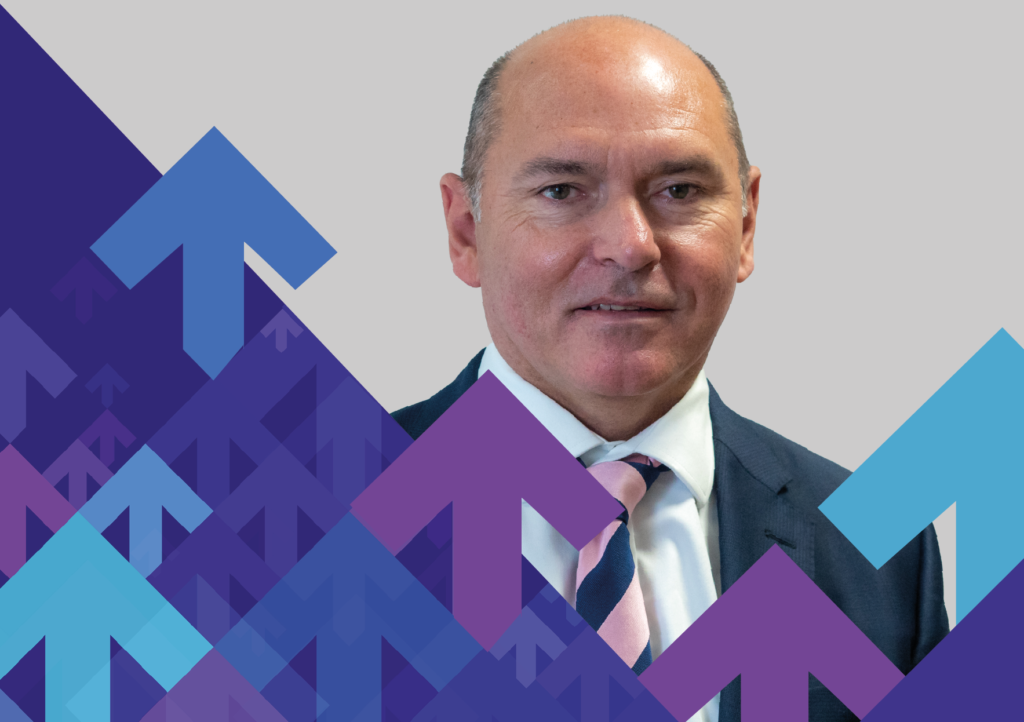
#5 Interview with Sir James Mackey, Chief Executive at Northumbria Healthcare NHS Foundation Trust, and National Director of Elective Recovery at NHS England
We were delighted to have the chance to talk to Sir James Mackey as one of the most senior and experienced leaders in the NHS. His career in the NHS began in 1990 as an accountant and, over the past 32 years he has worked across many roles and in very senior leadership positions at local, regional and national level. He shares his candid and considered views on the challenges faced, the ambition needed and the inspiration which must be embedded in leaders today and tomorrow in the NHS. People and patients at the heart of the care – always.
What inspired you to work in healthcare?
That’s a good question. It wasn’t a conscious decision, I actually trained to be an accountant in local government, and when I qualified I was looking for a change and to try out management in practise. On the back of the market reforms of the NHS in 1990, a number of new roles for qualified accountants were created so I joined the NHS then and didn’t expect to stay very long. However, I was completely taken by it and have been here in different roles now for 32 years. I really didn’t fully understand how much it would mean to work in healthcare until I did it – it gets into your bones.
The NHS is absolutely part of local society in Northumbria – we are the biggest employer in the area and that brings a huge responsibility, and we’re all much more aware of that now with the Covid impact making this more clear. We employ close to 11,000 people in total – over 2.5 % of the local population and, when you add in their family and friends, it is huge – so it’s very hard to not just get completely caught up and immersed in it and genuinely see people doing wonderful things all the time.
Delivering health outcomes well needs everybody pulling together. What barriers did you find in the way of better collaborative working, and how were you able to dismantle them?
In the early days there was a lot more tension across the Organisation and NHS more broadly and almost stereotyped personalities would take roles and be at odds with other departments over resources (for example, the physician/surgeon tension which used to be a big thing). Over time, this has really changed and different perspectives (which have always existed) are welcomed but work in a more collaborative way. There is much greater interaction across primary and secondary care now and between organisations today.
There are different attitudes to risk and different professions are trained differently (eg. social care people vs NHS) so they see things through another lens. But almost always in healthcare, people are actually motivated by the same thing: helping patients.
If we can remove the barriers of limited resource, dysfunctional organisational behaviour or lack of capacity then people can really focus on the area that motivates them all: patient care. The really hard bit is to keep stretching standards especially when resources are tight, but if we acknowledge that there are different perspectives and people look at problems in an alternative way that’s actually a strength. From that, you can get better decisions or better outcomes rather than try to make everybody have the same view.
Workforce is a challenge for every organisation in healthcare. What is your advice for leadership dealing with this challenge?
We’re all spending a lot of time focusing on it and it’s often presented as a workforce crisis because we haven’t got enough people, but in reality we have more staff than we had pre-Covid. The NHS has approximately nine per cent more people than three years ago, which isn’t very widely known and understood so we do need to understand the context, the circumstances and what this means for productivity and also how we can help our people feel more in control of their workloads and enjoy what they are doing.
What we’re experiencing is not just in health care, but in every other part of society. After the last two and a half years there is a bit of productivity drag and things remain complex and messy. It has been a tough time right across communities, industry and all sectors – the workforce is tired and worried and we need to understand and acknowledge this, but we also need to think about how we can work back to something more normal.
My advice is to try and listen to people about what it means for them and see it from their perspective. In healthcare especially we need to listen to patients, because I think there is a real risk that the service becomes separated from the view of the patient, and the frustration about the NHS’ inability to respond to their needs becomes even greater; that’s a really dangerous place for us to be.
It is our job as leaders to help navigate through it, to provide hope and optimism and outline a plan or path ahead. We need to offer a sense of positivity, hope and psychological safety and give staff a sense they are working in an organisation that knows what it is doing and cares. Things weren’t brilliant in 2019 across the NHS, so we aren’t looking to go backwards. We want to go forwards, improve and help support our staff in the next stage of all of our lives, post-Covid. We have also learned a lot so we mustn’t lose that.
A job like mine in the NHS comes with privilege and great expectation, and society depends on us. There’s evidence internationally of towns where health care facilities are diluted or taken away and that removes the heart of the area and the town dies. So we do know that there’s a lot riding on us. It is quite a thing to get your head round but it is energising for me. It can paralyse you if you’re not careful though.
What attributes do you look for in senior leaders in the sector?
With all potential leaders in the NHS, they have strong raw ingredients: they’re bright, educated and have achieved different professional qualifications and gained great experience. So, quickly, it becomes the behavioural things you look at – resilience, agility and flexibility, responsiveness etc being absolutely key. Healthcare is hard and as a leader, if you’re not careful, it can wear you out and that will really have an impact. So, self awareness and ability to manage self are also very important.
Leaders also really need to be able to work in a team and be a good colleague. They need to have high standards and have ambition to continue improving standards – driven but in a humane way. Healthcare is definitely not for narcissists – it is a team and people business and we need to find that balance and ensure we have the right people and mechanisms in place to keep people at the heart of healthcare.
What advice would you give to aspiring leaders in healthcare?
I met with our aspiring directors recently to discuss where we were in the latest version of Covid complexity and get their thoughts on what needed to change for the next phase. I was struggling to consolidate down my advice as I was really trying to think of the very best things I could offer and be helpful in my views. Firstly, I told them we cannot normalise poor standards, however hard things get. We cannot stand still in healthcare and no matter what, we need to be trying to move things forward and make standards better every day – if you think you are standing still in healthcare you are actually moving backwards, and quickly. An example is to never walk past the empty bag of crisps on the corridor floor – always pick it up – because a failure to do so can reset standards at a lower level. Another is never pass a colleague or patient without saying hello.
The second bit, which I think is really relevant now, is don’t expect somebody to come in and offer you time to think. You need to create the capacity for your own headspace. Leaders need to manage themselves and make sure they have the mechanisms to find time to create and develop their own ambition. Think about where and what you would like next for your People and Organisation.
And the final point is that leadership in healthcare is a hugely privileged job to be in and you get to see wonderful things happen. That comes with the price of expectation on how to manage it. That is why managing yourself is so important – as it then gives you time to think about how you manage and influence others also. In doing this, try to remember how great it is, and find joy in the privilege of what you are doing.
What makes a Board in the NHS work well and how does a CEO help with effective Board contribution and oversight?
I’ve had around 14 Board Chairs throughout my career and it is always very important to prioritise getting this relationship right. There should be challenge in it, but enough support, trust and respect to make it a healthy, functional relationship. I am lucky to have had great people to work with in that relationship.
In addition to that, it is important to get the right people on the Board for the task you’ve got at that time. The right skills, personalities, diversity of experience and thought should be sought at the right point. I expect that to change over time so the CEO and Chair are constantly keeping an eye on the dynamics of the Board and we work really hard at that. We need to feel like a team but with enough check and balance, independence of mind and challenge in discussion. That challenge must be respectful and professional and certainly not personal.
I don’t want our Board to rely solely on reports, they need to connect with the reality of the care too and have it brought to life for them. It is about people at the end of the day, not about numbers. As an example I shifted some committee meetings to our most pressured site recently as I wanted them to see there are really challenging areas, despite our performance reports giving very positive assurance. Some of our colleagues took our non-executive Board members around A&E, which is a very pressured environment, to show them some of the challenges and highlight how we are always trying to make it better, even if we don’t always get it right.
Technology was a great enabler for our Board during lockdowns but they were always very keen to get back on site as quickly as they could. We do talk about the ‘scratch and sniff’ test in healthcare and that is important for our Board too. You can tell a lot by speaking to people, eye contact and just being there. It brings the formality of the governance to life and safeguards against a collusive and cosy situation, which is never helpful for any healthcare Board – it is actually very dangerous.
Download a PDF of the interview
Road to Recovery Series