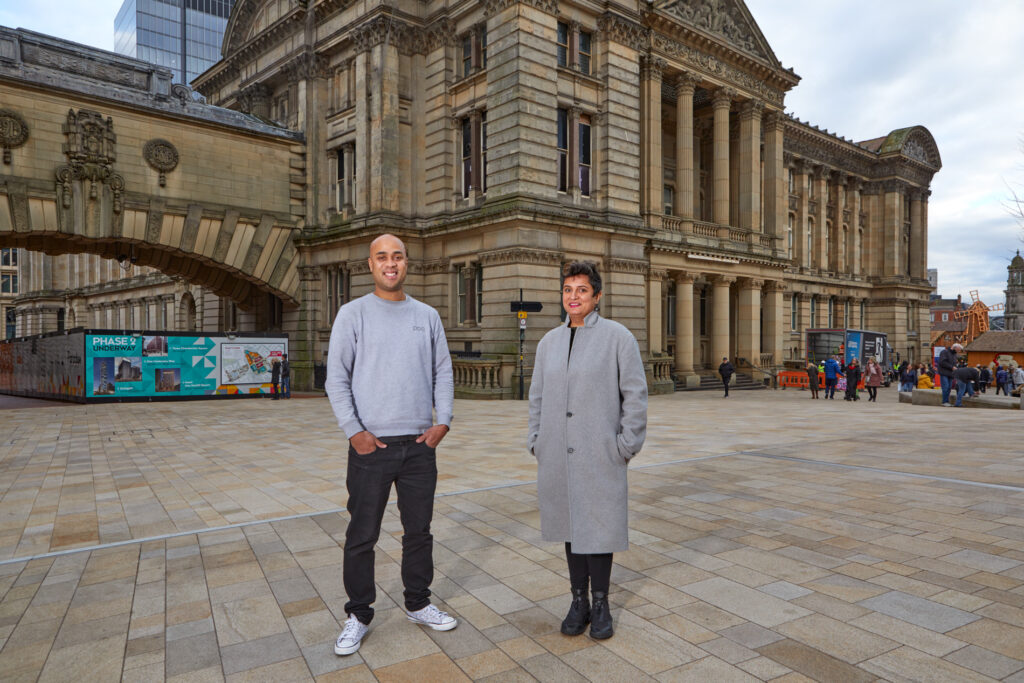
While there are examples of co-Directors in Arts and Culture the job share model at CEO level is practically unheard of. However, there are two people who are making it a model to watch and learn from. They are Sara Wajid and Zak Mensah – joint CEOs of Birmingham Museums Trust. Appointed in November 2020 we were delighted that they found time to talk to us about their partnership, navigating leadership together through a pandemic and a major capital renovation project.
Sara and Zak met originally through Twitter and as members of the Museum Detox – a network for people of colour who work in museums, galleries, libraries, archives, and the heritage sector. The pair come from different backgrounds and personal and professional experiences but came together to apply for this role. Through collaboration, creativity and endless curiosity, they are making big waves and bringing a fresh perspective to senior leadership.
Sara was previously Head of Engagement for the Museum of London’s capital project, and prior to that she was Head of Interpretation at Birmingham Museums Trust. Zak was Head of Transformation within Culture & Creative Industries at Bristol City Council.
The concept of the co-CEO as a job share is a fairly unusual one in the Arts and Culture world. How have you made it a success?
Sara: I have worked in a job share previously, albeit in a much smaller organisation, so I had confidence in the model. From the start we had a shared understanding of the benefits of a job share and how it could work for us and for Birmingham Museums Trust. That hasn’t changed much over the last 18 months, right from our very first conversation about it. Essentially, we were both equally keen to learn from each other and share the responsibility and the adventure of being new CEOs. We both appreciate the diversity of thought and the breadth of life experience that we individually bring to make a duo. Many of the usual things about good working relationships apply – mutual respect, good communication and listening.
Ultimately, we get on well on a personal level. Zak is a hugely likable and positive person and I’m proud to be co-CEO alongside him. It’s a privilege to work with him and it’s fun, which has been so important in this strange and unusual time.
There’s another aspect to our collaboration too – the fact that we are both people of colour in leadership which is extremely rare in Arts and Culture. Our friend and colleague, Gaylene Gould, who runs the Brilliant Routes programme for leaders of colour (along with Clore Leadership) talks about the experience of being ‘the only one’: the only visible minority in the room or at the top table and the emotional toll this can take. As we are both people of colour we relieve each other of that particular burden of representation and we have that level of solidarity, even though we have quite different backgrounds and life circumstances.
Zak: The pandemic encouraged me, as well as many others, to reflect on my own working practices and what I wanted to do. I am very interested personally and professionally in the future of work and this time has shown me that the ‘typical model’ isn’t necessarily always the right one. For me personally, it certainly has been true. When we applied for the job share, Sara and I came together with the intention of making that change, showing others that it is possible to do this. We have kicked off our leadership with that transformation idea, we wanted to say: ‘be the change that you seek to make.’ As far as we are aware we are the only Co-CEOs in the Museums world, certainly in the UK.
I hadn’t been in a job share previously but when Sara and I saw this role advertised it felt like there were more skills and experience needed than one person could offer. We have complementary skill sets and as a pair we believe that we offer far greater ROI, in many ways, than one single individual could for this role, and it also adds resilience to the business model. It makes life easier when looking at specific projects as we can literally have the CEO in two places at the same time.
A lot of leadership roles present challenges around what needs to be given up. For example, I have a young family. It would extremely difficult to be a full time CEO as well as being a father and husband. We have used this job share to share both this burden and the opportunity.
“We kicked off our leadership with that transformation idea, we wanted to say: be the change that you seek to make.”
The CEO job can also be a really lonely one. You don’t always have time to think about all the options and there can be a lot of pressure on the ego. When they are two people it brings a greater level of objectivity. Decisions might not always be made as quickly with two but I believe that they are always the better decisions.
We are a real team, and I liken it to the Le Mans 24 hour race. We are a team driving one car and swapping as needed. A lot of hard graft and skill is required, but you get to share that experience and the rough and smooth terrain together. It really has opened my eyes to a new working model and I am very happy to be in this position with Sara.
What individual elements do you bring to the partnership?
Sara: We come from quite different professional backgrounds. We’re a decade apart in age and grew up in quite different places and circumstances so we have different social attitudes and takes on the world and together it works to bring a diverse view from the CEO.
I have worked in a wide variety of creative industries and several different museums, which brings a different network of contacts and experience of developing capital projects. For example, I previously worked on developing the forthcoming new Museum of London. I’ve been grappling with questions of equity, culture and power for around 30 years now, both as a journalist and cultural producer, so I bring that to our shared creative vision.
Zak brings a strong mastery of organisational transformation (he was head of transformation in culture and creative industries at Bristol City Council) and having been in the senior team at Bristol culture he’s got experience of running and managing a complex heritage organisation and working closely with the council. He also has a passion and knowledge of the potential of digital technology.
Zak: My background is in computing and I always think from a user needs perspective, trying to find constraints and how to overcome them. I am also used to and enjoy working at pace. I have experience working on complex commercial projects, which require absorbing a lot of information and making decision quickly. I have gained this largely working in technology, but also having worked at Bristol City Council and the University of Leicester.
Technology really is my passion and previously this wouldn’t have been as embedded in all of our thinking, but the pandemic has forced us to think much more about it. We have had be more flexible and find new ways to engage with our people and our places. We have had to consider the real gains made through this new flexibility, such as productivity, wellbeing and a mix of skills, and we must learn from those and build them into future ways of working, aided by technology. It is enabling us to plant seeds for the future.
Sara has lots of experience working on capital projects, and she has a clear view on how to deliver these massive scale initiatives, with the right engagement strategy. This is helped beautifully with Sara’s amazing story-telling ability. This comes from her journalistic background and it really makes an impact by building excitement for the projects in a wide variety of audiences.
With our broad mix of skills and experience we can identify clear leaders on each area and that really highlights another benefit of a job share like ours.
Over a year into the job, what have you enjoyed most about this time? What has challenged you most?
Sara: I have really enjoyed learning so much all the time. From learning about Birmingham through the biographies of Brummies like Pete Paphides and David Harewood and the work of local artists and creatives, to learning how to work remotely well or understand the challenges facing this region. Overall, I’ve loved reconnecting with Birmingham itself – the place delights me and makes me hopeful for the future of the country.
The main challenge has been forming working relationships without much face-to-face contact, which has made the collaborative development of a radical and creative vision more constrained.
Zak: Negotiating the world during a pandemic is extremely fraught and a difficult thing to do. However, it has allowed us to really focus on what we do it for and why – and I have enjoyed that. It makes you question your worth as an organisation and made us think so much more about our mission and what we can contribute. For us the idea of social trust is massive and one of my personal straplines is: ‘be more useful to more people’. Civic spaces are getting fewer and fewer and to have spaces that people trust are so important. We are responsible for telling stories of the past present and future and that is so exciting and a real privilege.
We have also focused heavily on the mental health of our staff and this continues to be so important. As part of that Sara and I have taken the time to really understand each other and I am very proud to lead together at this point in the Museums’ history.
The most challenging elements have been lack of face-to-face with our staff and visitors, and that does continue but with the partial reopening it will be fantastic to have that opportunity. There is also an element of learning on the job and through a pandemic. Tomorrow will come regardless and you have to do it all over again. You need to make decisions, take chances and experiment.
What have you each learned in the last 12 months about leadership, particularly during a pandemic?
Sara: That it’s better together!
Zak: The only way to learn to be a CEO is to be a CEO. You make some mistakes and people are watching you do those, but if you treat it like a series of experiments and take feedback you learn quite quickly – and that challenge is also an opportunity. Ground yourself in your work and with the people you are working with and talk and learn from people who understand the challenges.
We need to accept and recognise that we are all human. I have two young kids, and they have jumped on the camera from time to time, or they pull away me from a call to deal with them. This has really resonated with people, staff and our wider networks, who have sent me messages showing that they really feel they can ‘bring themselves to work’ (metaphorically) and now more than ever we need to encourage this. At the start of the pandemic that wasn’t there but we really need to prioritise people better and find ways to help.
Does being part time in your role allow you to explore other professional or personal interests – can you share any examples?
Sara: I’d be lying if I said I’ve had the mental energy for many personal interests beyond work but proper rest has been absolutely crucial in the last year and working part-time has enabled that. Just decompressing and taking the time to absorb and acknowledge, and start to process the change to our world has been vital.
I’ve also been able to keep up and pursue my commitment to equalities and anti-racism agendas because I have some space to read and connect with fellow cultural activists. I have been able to continue my role as Trustee of Pitt Rivers Museum and with the Space Invaders collective for gender equity in museums. Those are very important to me and help keep my energy up. They also feed the day job fairly directly.
Zak: Going part time has allowed me to scratch some of my own itches in my professional curiosity. I am using my long term interest in technology to help others. Lots of people paid it forward through my career and now I want to give back. I support organisations in ways such as conceiving their digital strategies or with transformation projects. I am a Trustee for the Association for Cultural Enterprises, and more recently a Trustee of Culture 24, an organisation that helps people better harness technology.
I am also interested in lifelong learning- and I have signed up to an introduction to statistics. It will have a work application, but I am also interested on a personal basis as the world revolves around statistics.
I have been reading a lot – I read 20 books last year. Reading is so important to feed your curiosity and I do really make time for it. Finally, my wife is also in a job share and sometimes we get to go for a walk or bike ride during the week – without the kids – and that is heaven.
The Birmingham Museum and Art Gallery has been closed for a year but partially re-opened in April 2022. What was your ambition for the reopening?
Zak: This is the first opportunity to support the recovery from the pandemic and highlight the real value in civic spaces, stoking curiosity and promoting wellbeing. It gives people a first glance at some of the change, but it does remain largely still a building site as this point.
We have been working with a group of young people from an agency in Birmingham called Beat Freaks to deliver a redisplay of the Round Room which hasn’t been changed in approximately 40 years. It is a great chance for us to show new works and an opportunity to work with young people in our local community to give a taste and sign of what is to come. When we do fully reopen in 2024 our approach to inclusion and participation is paramount. It won’t be us saying what we think is best, we will work with different groups, and particularly young people to curate these spaces. It is not something the Birmingham Museums Trust has done at this scale before and we’re really excited to take it to the next level.
Birmingham has an exciting year ahead with the Commonwealth Games in 2022, and associated cultural festival.
What part can the Birmingham Museums play in supporting the city and its people?
Zak: We’re much loved as a space in the city. We have been open for several weeks since February and will be open through until the end of Summer. It will offer a different cultural experience whilst people are out enjoying the Games and Birmingham city. Our visitors are typically local or regionally based and we are confident that they will return and support this valued civic space and get a glimpse of Birmingham’s past, present and future.
You’ve shared a vision for the museums to be ‘more useful to more people’; what have you learned about the potential role for museums in your conversations with different communities and individuals around the city over this past year?
Zak: Museums by their very nature are social places. The past 24 months have highlighted the importance of social fabric and museums cut across so many interests and areas and will remain a special place for lots of different life experiences.
They help to explain why we are where we are today as a society and where we have the potential to go in the future. This can be done both in person and online and I view it as a portal to another place. Engagement across so many groups and individuals in our community is essential and we are continuously thinking about how we can enhance this.
“Technology is a window into mass participation for us”
We have all become much more accustomed to technology in our lives, even more so since the pandemic began. How is this being reflected in your approach to the Museums?
Zak: I believe we need and want to have digital everywhere. Technology is a window into mass participation for us. Nothing else has the scale, scope or speed that technology offers. When I talk to the team about it, I encourage them to think of us a bit like a modern-day media company. Ultimately, we broadcast information and we have to engage people with interesting content which can be more personalised than ever before. In young people the use of screen time is going up but the consumption of live programming is going down and we need to be aware and adapt our approach to these trends.
For example, previously individuals wouldn’t get easy access to a curator before but as time goes on we will be able to offer sessions with curators who will be able to answer questions and respond to people directly and dynamically.
With people working and living more remotely we have more potential audiences and technology gives us opportunities there. However, there is a divide and digital poverty is real. One of our challenges is how can we invest in our assets and spaces with technology and make sure that we don’t leave people behind. We also need to ensure digital literacy skills amongst staff.
In our museums we take people back through the history of technology, computing, manufacturing and engineering and it is amazing to be able to share this. I guess the major challenge is balancing the new and shiny with the long-established. People have still got to be able to tell stories and the story telling is what makes us human – technology just changes how we can tell them and brings new ways to bring objects and pictures to life.
What part can museums, art and culture play in evolving how we live, think and interact with one another?
Zak: Museums are perfectly placed to be environments that are open for debate – reflecting on how people used to be in the past and how they choose to be in the future. As we are collecting in perpetuity, you get a completely different understanding of the city through the generations. Civic spaces really remain to be of the people, for the people. It is a safe space to have differing views, conversations and discursive theorising, and that feels really important for everyone.