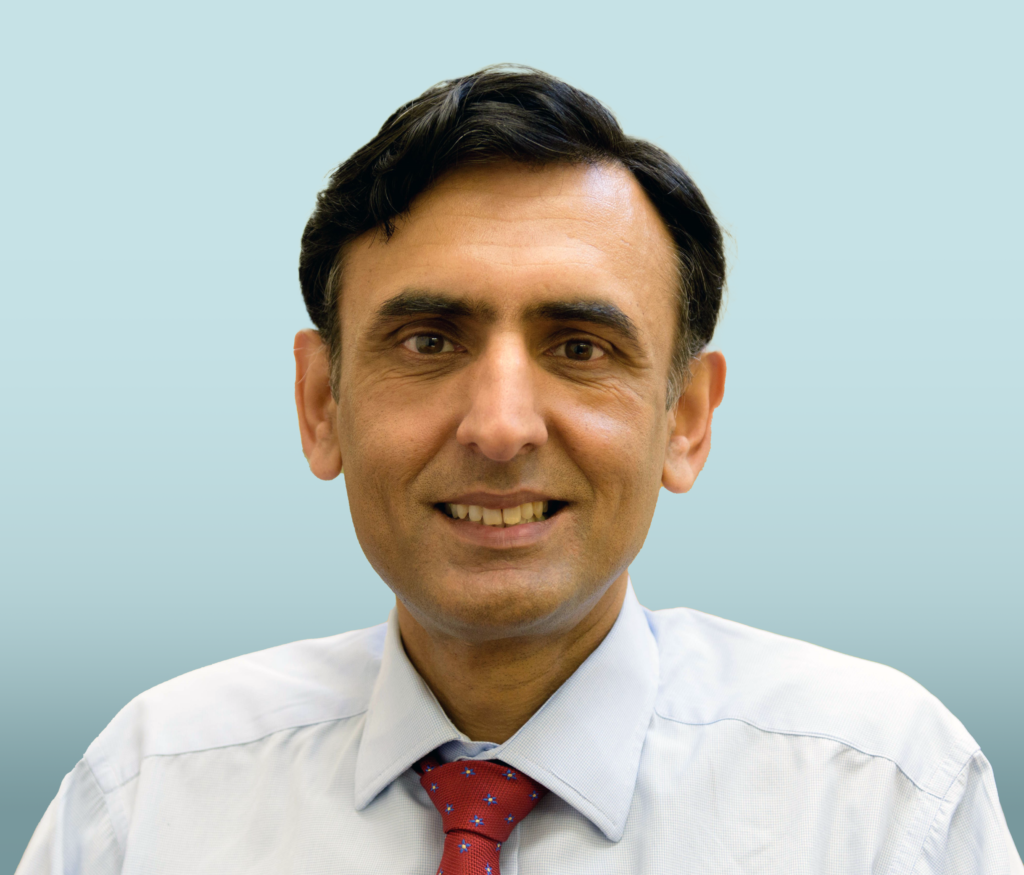
Professor Jas Pal Badyal was appointed Chief Scientific Adviser (CSA) to the Welsh Government in January 2023. In this interview he shares his hopes and ambition to share the positive impacts of science to the people of Wales and demonstrate the connection that it has to enhancing society today and in the future. His belief in collaboration at local and national level with the open sharing of views are integral to this aspiration for society, but also fundamental, in his view, to successful leadership where diversity of thought, evidence and discussion are embraced.
You were appointed as CSA in February 2023. Previously your experience was mainly in higher education. Can you tell us a bit about your previous work and what has encouraged you to make the career decisions you have?
As we speak, I have just completed my first 100 days in this role and I am really enjoying it. I like to push myself outside my comfort zone so this transition was something I was excited about.
I originally joined Durham University as an early career researcher after gaining a PhD from Cambridge University. Within the academic environment I have been able to translate my research into a more commercial context helping to establish three start-up companies within Durham’s chemistry department; the first of this kind for the department. It felt like a positive step and I took learnings from my time in Cambridge where there are a lot of start-up companies.
I really wanted to demonstrate the wider societal benefit of my science and support my research students by providing them with opportunities to work and lead in those companies.
Over more recent years, with my passion for science, I decided to make a bit of a change, and translate my research towards helping low-income countries, for example providing clean water in refugee camps and arid climates. I was excited, maybe naively, to engage with people and use science in a different way and to help make an impact. I really loved this work, but it was cut short with the Covid pandemic and my research team couldn’t travel.
It was at that point that I was approached by Saxton Bampfylde. Initially I was surprised they were asking me but when they explained the role, the impact it could have and the opportunity to raise the profile and application of science for wider societal benefit I was convinced. That is how I am here.
Are there benefits that you identify coming to this role and government sector as a leader from ‘outside’?
I have been told that I am a different CSA to those they have had before in Wales. I come from an academic background, but have also brought my knowledge of how science impacts the wider world and benefits people’s lives through lots of different applications. I like to focus on innovation and global connectedness, and this reflects both my experiences in academia having travelled extensively, but also in industry collaborating with many of the world’s leading companies. It has brought a number of advantages so far and I am looking forward to how this experience can impact the role further.
You were previously based in Durham and now working in Wales for the first time. Has this brought any additional elements to the transition to this role that you could share?
There are actually a lot of similarities between Wales and the North East, culturally and geographically. People are very friendly, open and welcoming with a really strong sense of community. The landscape is not entirely different either and so I do feel at home.
The challenges are also similar between the two areas with social deprivation, a lack of social mobility and low industrialisation apparent in both.
The CSA role in a devolved government – how do you work alongside your counterparts in other devolved and central roles? Does this make collaboration more of a priority?
Each government has its own respective priorities, and we also need to follow the programmes of government but there is a considerable amount of sharing. Particularly we share science and scientific evidence. It’s really up to government policy teams what they do with the evidence. It has been a fantastic way to collaborate, build networks and look at problems and challenges through the lens of science.
I meet with CSA colleagues from England, Scotland and Northern Ireland on a regular basis and this really encourages interaction and collaboration. There are also opportunities to interact with international CSAs too which is really important in relation to for example tackling climate change.
Do you believe that the profile of the CSA has risen post-Covid? What benefits or challenges does this bring?
It has definitely risen, and that is certainly due to Sir Patrick Vallance and Professor Sir Chris Whitty who both did a truly brilliant job during the pandemic. I have found that it’s actually a good route or anchor point in terms of opening up conversations with people who aren’t from a science background. Everybody can relate to experiences during Covid and that means conversations with those in Government or the general public are easier to link back to science and its impacts.
There is also a challenge that memories fade, and we come up against many other pressing issues, such as the cost of living crisis. There is a danger that science may drop in priority over the longer term. But we are working hard to sustain its profile as it is so important to make a difference in our everyday lives and for the longer term solutions to multiple issues. Science really does benefit society and we have seen this very much for the NHS with the incredible work on vaccines which have saved lives and reduced burden on the service.
How accessible is research and scientific funding for Welsh projects?
Access to funding is similar in many ways to the rest of the UK with some specific Welsh Government schemes also available. The main funding body is UKRI which is obviously UK-wide.
What are the key priorities in your role – both as a scientist and as a leader?
On a personal level, I really enjoy helping people succeed. I always have and that is probably why I ended up in education rather than going into industry. In my role I want to make the lives of people in Wales better through science. It doesn’t necessarily mean through research, but through science.
For example, raising the profile of STEM in schools is so important, because whilst learning the academic concepts, you are also learning about human values too. In science there is a strong emphasis on truth and proof through evidence and experiment. For example, if people have good knowledge of science, it can help them to have a better appreciation of healthier lifestyles, and adapt to new technologies, including AI and other world-changing systems.
Currently there is a huge challenge for an older demographic who can’t access some of these technologies and aren’t aware of potential benefits which can create fear and scepticism, and so we need better engagement with science to be able to help address this.
More broadly, a greater awareness and adoption of science has great potential to bring economic impact too by driving greater research, development and prosperity. This is important for Wales given the historical closures of heavy industries and impact upon local Welsh communities.
What in your view are the key characteristics required in a leader in our society today?
I think the ability to look at topics and situations from very different perspectives is crucial in a leader and that comes from having different lived experiences. For example, I had no previous experience in government, but I try to look at problems from other perspectives and that can bring new insights and benefits. With only having one type of experience then there’s the danger of groupthink. It is really important to decouple evidence from perception and maintain that mindset.
A good leader also really needs good interpersonal skills, which again comes from experience. For myself I have learnt from teaching students in universities to talking to CEOs of large multinational US companies, as well as finding ways to implement technological solutions in low income countries through negotiating. Those are all skills that provide more ability to interact and work with people.
What would you identify as the biggest threat to good leadership?
The biggest threat is definitely groupthink. It’s important to decouple evidence from perceptions, but if you have strong evidence then you should not be fearful of making decisions and be more willing to engage and explain. Proof and discussion are important factors to help make an organisation more effective, fair, and inclusive.