We are delighted to bring you a series of interviews from a range of inspiring and emerging leaders in the Schools and Education sector to consider what is and what can be done to expand talent pools at senior executive and non-executive levels. We look at barriers and opportunities and look at how both individual passion and collaborative engagement can make the development and nurturing of talent a standard approach across the sector. Each interviewee has generously and honestly shared their reflections, hopes and advice for those succeeding to leadership in the sector over the next decade.
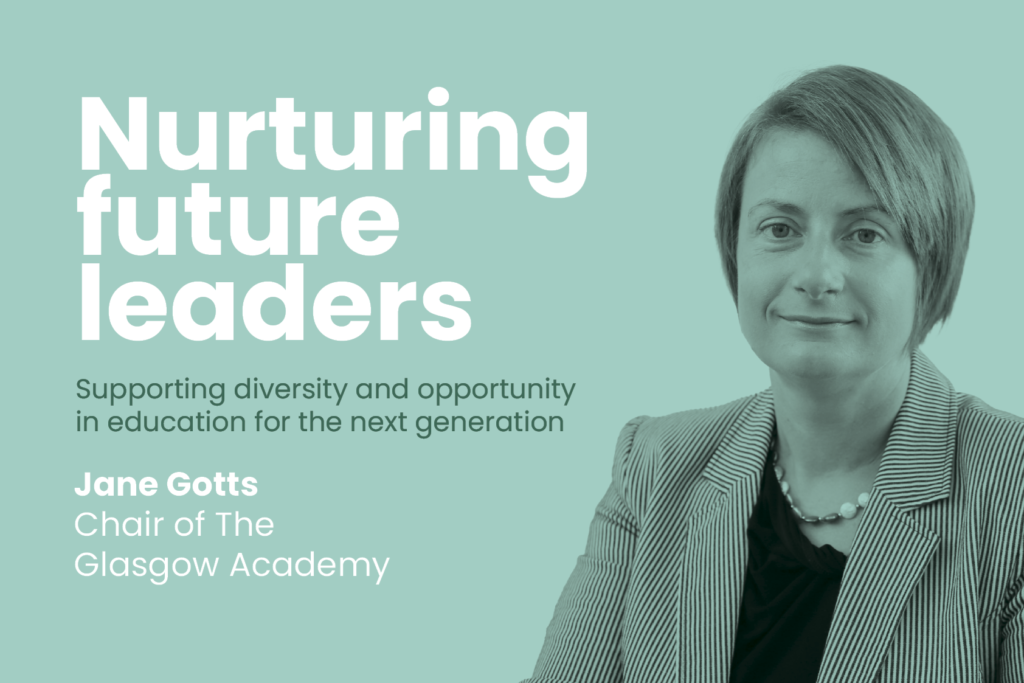
For our second interview, we welcome Jane Gotts, Chair of The Glasgow Academy, who shares her insights on the evolution of the school’s ethos following its transition to co-education in 1993. She discusses the challenges facing the independent education sector, the importance of diversity and leadership development, and the steps Glasgow Academy is taking to stay ahead of the curve in a rapidly changing educational landscape.
Jane, you are Chair of The Glasgow Academy. Originally a boy’s school, it merged fully with Westbourne School for Girls to become co-educational in 1993. How has the ethos of the school evolved since that point?
The approach to single sex education has changed in the UK, and there have been a number of mergers since the 1990’s with more parents seeming to want the co-educational option for their children.
Bringing girls into a boy’s school did, as you would imagine, change the dynamics and I think for a number of years that probably presented some challenges, both for teachers and pupils who were used to the single sex environment. However, we have seen that it really did develop a greater sense of inclusivity, not just literally, but also in the values it came to embed across the school. It has been over 30 years now since the since the merger and the school has been in a very good place for a long time.
With regards to the ethos of Glasgow Academy, it is still very much centred in the tradition of the school as a War Memorial Trust, and the motto Serva Fidem (Keep Faith) remains strongly apparent.
Alumni who come back to visit the school who attended before the merger do see it as a very different learning environment but can still see its strong values and commitment to education. However, the key thing is that both Glasgow Academy and Westbourne moved with the times – they had to, and it has created a very strong and proud alumni and staff along the way. Thirty years on and the sector is facing more challenges, and we need to stay ahead of these again.
As you say the independent sector is facing some areas of challenge, how is Glasgow Academy working to stay ahead of these and what are you prioritising?
There are many challenges, and you cannot really take them in isolation, but affordability of fees is the big thing. The independent sector has shrunk overall, and also here in the West of Scotland, in the last 20 years. Glasgow Academy has been quite fortunate that our school roll has increased and then held steady. We don’t take that for granted and we invest a lot of time and energy into early years’ education and talking about the benefits of an independent education early on. But we are mindful that it is a big financial commitment.
We now have the VAT addition in January, but we have been planning for that for over a year and making sure that the school is in a good financial position to allow us to try and mitigate the impact on parents. We’ve been quite open with our parents on what we’ve been doing around that, and we have held fees for this year at the rate that they were told in April.
This allows us as a governing body to run through different scenarios and look at different financial options. We have a bit of breathing space, but we are working at pace to do this. We will still undertake engagement with our MPs along with other schools and SCIS, however our priority is very much on the impact to families and trying to mitigate that.
We also have a continuing challenge in the increase in the number of pupils, particularly since Covid, coming back or joining the school with additional support or learning needs and we have seen an increase in the number of our pupils needing support for mental health. We’ve really invested in this over the last few years, both increasing what is available, but also in training and educating our teachers in these areas so they can offer the best support to pupils.
We have the financial challenges, but then wider societal challenges around that. At the heart of everything that we do as a governing body are the pupils and staff. We want our school to be a happy place where children can come in, have their lessons, and receive a good education, from motivated and positive staff.
There are other interesting areas coming up on the horizon, like the rise of artificial intelligence – something that barely was on our radar a few years ago. We need to think about how we embrace that and mitigate challenges around it. But, also how we address that in education and what we need to be offering to pupils and how we educate them and prepare them for a working world and the types of jobs that will exist in the 21st century.
What do you believe is hindering a greater representation of women at senior levels of schools education in the UK? What can and is being done to address this?
I have this conversation a lot with senior female leaders within our school and also with the Rector. On our staff we have a greater percentage of females than males, and that is quite standard in many schools, particularly in primary and early years education. But as you start to go up the funnel into senior leadership the number of women drops. I’ve tried to kind of unpick that here and part of me thinks there’s a bit of a historical legacy from it being a boy’s school. While that is just my perception, we are actively developing a leadership program for our female staff who are in senior positions already but are looking to make that next step. We are looking at the barriers stopping them and to make sure that we’re structured properly to allow female leaders to progress.
We are recruiting for a new Rector and we have had female candidates but I still think at the top level it is dominated by men. That is not different to other sectors. It remains the case that a lot of women reach a certain level and don’t move beyond that and I believe it is up to the existing leaders within those organisations or those businesses to actually address why that is and remove any barriers. When I took over as Chair in November it was something I was focused on and I do want to ensure there is a lasting legacy here that shows we are committed to this.
Is enough consideration being given to increasing diversity at the recruitment stage?
I do think it is important that a recruitment firm knows your organisation and the Chair or Board relatively well to know what they want. For us, they know we want a diverse candidate pool but it is still very much about the best person for the job. It is important to ensure that the language around the job and the description of the role is right to ensure greater diversity of candidates coming forward.
In your experience in Scotland and from across other sectors is their more the Schools sector can learn or borrow to improve this imbalance?
I wouldn’t say there’s any particular one sector that is a shining light in the UK; every sector has its challenges. I believe it comes from looking internally and considering what the barriers and structures are that might be causing an imbalance.
In our case we have a small leadership team with a very low staff turnover. That is positive in many ways and important that we keep our staff, but that can mean opportunities for progression might be limited.
However, when I look at the school and my time on the Board here so much has changed, and what teachers are facing is very different, even in the last decade. We have a very different economic reality, greatly changed expectations from parents, more international focus, and we need to making much quicker decisions and living with constant change. Our Rector has led this brilliantly and collaborated well with others across the independent sector. We are still a place of education and nurture ultimately, but we need to think much more like a business than ever before – are we offering value, how are we using our assets and how are we ensuring staff are happy, feel supported and delivering at their best as much as possible.
What gives you cause for optimism in the education sector?
It can be easy to get bogged down in some of the negativity, but when the Board is having challenging conversations, we only need to look at the P1 class – see what fun they are having and it brings us back to why we are doing this. We also reflect on the legacy of former pupils who have gone before us who have come back and say that the school’s in a great place.
I have really great optimism in our teachers and their talent and that is very key. They are so talented and committed and really do go above and beyond what would be expected of them and the children respond to that. We really pride ourselves on our mantra of getting it right for every child and whatever the child’s talent is, the teachers will identify that and help them to flourish.
We are an ambitious school, and the Rector talks about ambition often. We’re not frightened to use that word, and I think it’s important to talk about being ambitious and giving our young people the best start in life that they can to enable them to go out into the world and be good citizens and make a positive difference to our world.
Finally, I believe our Board is well connected with our colleagues and wider school community. We know the staff better and speak regularly with the Rector and other senior leaders. We have to work together as a team if we want the school to succeed and the Board is very much invested in that. For those joining the Board, it is not about egos, it is about the skills and experience they can bring to help ensure the sustainability of our school long term.
Jane Gotts, Biography
Jane became Chair of the Glasgow Academy in November 2023 – the first female in the school’s history to hold this post having been educated at Westbourne School for Girls and The Glasgow Academy. She is also a founding partner and Director at GenAnalytics Ltd – a specialist data and insights consultancy focused on diversity and equality in the workplace. She has significant experience in business and economic consultancy, growing commercial revenue streams, strategic business planning and international business development.
Prior to setting up GenAnalytics Ltd Jane was Director of International Business Development at Glasgow Caledonian University with responsibility for driving the university’s international business development strategy in key overseas markets including the USA, South Africa and Brazil. She is also a non-executive director of an international recruitment firm based in Scotland. Jane has a degree in Politics from the University of Glasgow.
Saxton Bampfylde has a strong track record of identifying and placing leaders across a broad spectrum of schools and settings. We are continuously challenging the approach to increase diversity in the sector by encouraging a wider scope for candidates, as well as by supporting internal talent development. We believe there is a great opportunity for inclusion and the positive outcomes that delivers.
About our Schools’ practice
We have a firm commitment to the independent, maintained and commercial education sectors and are proud of the impact made by the appointments with which we have been involved. We advise a broad range of schools and educational organisations from the iconic and world-leading to the small and distinctive, supporting the appointment of Heads, Bursars, Chairs of Governors and business leaders.
For a discussion on how we can help to support your School’s next leadership appointment, please get in touch with Emma Hattersley, Head of Schools’ Practice.