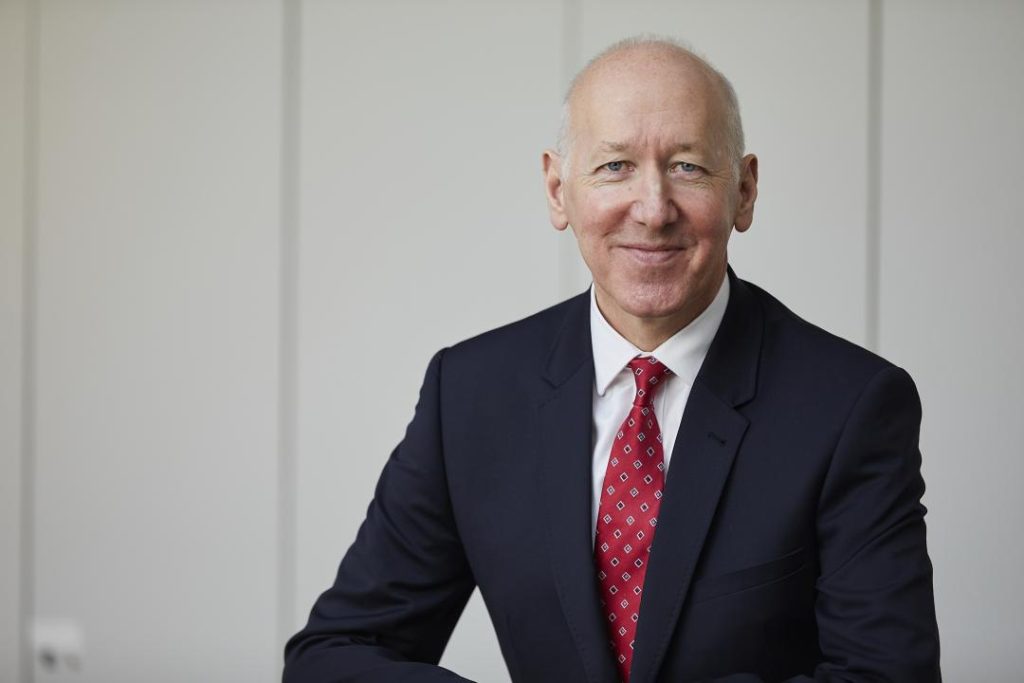

Interview by Mary Few, Partner & Head of Scotland
After a career that began on the shop floor and culminated in boardrooms shaping the UK’s infrastructure and energy future, Steve Scrimshaw has a story that exemplifies what grounded, purposeful leadership looks like. His career journey spans British manufacturing, global engineering, transport, and now the energy transition. I had the pleasure of speaking with Steve about his route to leadership, how he cuts through complexity, and the lessons he’s learned about people, purpose, and progress.
A career that spans steam, trains, and net zero
“It seems a long time ago that I walked through the door at CA Parsons as a mechanical technician at the tender age of 16,” Steve begins. “It was the same site where the first practical steam turbine for generating power was invented.”
From those early days maintaining power plants across the UK and overseas, Steve’s career evolved through senior leadership roles with Parsons, Northern Engineering Industries, Rolls-Royce, Mitsui Babcock, and eventually Siemens.
“I worked across service engineering, project and contract management, sales and general management,” he says. “I spent ten years running Siemens Mobility’s rolling stock division before returning to lead Siemens Energy in the UK and Ireland as CEO.”
Steve retired from executive life in 2024, but not from impact. He now holds two significant non-executive roles: as a Board Member at Network Rail and as Non-Executive Chairman of Windward Energy, a growing player in the energy sector.
This summer, Steve was awarded a CBE for services to British Manufacturing, Transport, and the Green Transition to Net Zero.
“I feel very humbled to receive the award,” he says. “But I also feel very privileged to have had the opportunity to work with so many brilliant people and organisations. The award is as much for them as it is for me.”
“You have to have a vision and a belief in the future you’re heading towards, and be able to articulate it in a way that inspires others to follow.”
On dreams, difference, and making things happen
When I asked Steve what he dreamed of as a young teenager, his answer was refreshingly honest.
“I didn’t want to be pigeonholed. I wanted to experience different businesses, different perspectives, build relationships and shape the future. I wanted to make a difference.”
That desire for impact, not just employment, has clearly underpinned his approach to leadership throughout his career.
“You have to have a vision and a belief in the future you’re heading towards, and be able to articulate it in a way that inspires others to follow.”
Leadership in a sector defined by transition
At Windward Energy, Steve is once again in the thick of change, this time, leading at the intersection of infrastructure, innovation, and energy policy. So what does good leadership look like when the path ahead is constantly shifting?
“You have to have a vision and a belief in the future you’re heading towards, and be able to articulate it in a way that inspires others to follow,” he says.
But he’s quick to acknowledge the challenge that comes with leading through transformation.
“People often frame the energy transition as a choice between one technology or another. I used to describe it as: we know it’s that direction, but the exact route isn’t clear yet. As you move forward, you have to be able to pivot, to adjust course as markets evolve, as technology advances, as policy changes.”
He’s also clear that no single company or technology will make the difference alone.
“We’re moving to a collaborative growth culture,” he explains. “That means breaking down silos, working across businesses, and truly collaborating. The energy transition is going to be punctuated by collaboration on a scale we haven’t seen before, and I think that’s the big difference.”
One of Steve’s strengths is making big, abstract ideas personal and relatable.
“I try to bring it back to our everyday lives,” he explains. “Think about how we’ve adapted since COVID: Teams calls, online banking, cybersecurity, electric vehicles. The energy transition is the same, it becomes real when people imagine solar panels on their roof, an EV on the drive, not having a gas boiler. That’s how you make the future tangible.”
And crucially, how you bring people with you.
“If you can explain why it matters and what it means, not just in technical terms, but in terms of legacy, for your kids and grandkids, people want to be part of it.”
From corporate scale to entrepreneurial agility
Transitioning from Siemens, a global engineering powerhouse, to Windward Energy, a fast-growing energy company, has been a shift in pace and proximity.
“In a more entrepreneurial setting, you feel the impact of your decisions much faster. There are shorter chains of command, more direct accountability. And a real appetite to take calculated risks and attract investment,” he says.
Still, Steve emphasises the value of both worlds.
“Siemens and Siemens Energy remain at the pinnacle of engineering excellence. But what’s exciting at Windward is building something future-facing and agile, while drawing on the discipline and rigour of those bigger environments.”
“Be humble. Don’t be ashamed to show some vulnerability. Treat people with respect and earn their support. You can make great things happen with small, dedicated teams.”
Cutting through complexity
In a sector full of moving parts, policy, regulation, markets, technology, Steve is pragmatic.
“There are huge opportunities and some very complex challenges,” he says. “Some markets are still nascent, needing government support and creative business models to stimulate innovation while protecting consumers and taxpayers.”
“But at the end of the day, there needs to be demand. Net zero and flexible assets have to be affordable, and it has to make sense for investors. Customers care less about the specific technology and more about having reliable, clean, affordable energy.”
“Be humble. Don’t be ashamed to show some vulnerability. Treat people with respect and earn their support. You can make great things happen with small, dedicated teams.”
On humility, impact, and lessons learned
When asked who inspires him, Steve says there are too many to name, but what they have in common is drive, ambition, and the way they engage with people.
Over the course of a career that’s spanned global engineering giants and agile entrepreneurial ventures, Steve has learned that good leadership rarely comes from having all the answers. Instead, it’s about listening, staying humble, and never being too senior to learn.
“Listen to people at all levels in the organisation,” he says. “Be humble. Don’t be ashamed to show some vulnerability. Treat people with respect and earn their support. You can make great things happen with small, dedicated teams.”
One lesson came unexpectedly, from a reverse mentor who challenged how he presented himself to the world.
“I thought I had a wonderful LinkedIn profile,” he laughs. “She came back and said, ‘It doesn’t say anything about you.’ I said, ‘Of course it does!’ She said, ‘No, it doesn’t.’ And she was right. When you’ve been entrenched in businesses for years, you can forget that it’s people who connect with one another, not job titles or project portfolios.”
That moment sparked a broader reflection on what people look for in leaders today.
“They’re not just looking for a job to go to. They’re looking for purpose. For values. For connection. And it’s in those moments of perspective, the ones that challenge your assumptions, that real growth happens. People like that inspire me.”
Final Thoughts
Steve’s leadership journey is a lesson in clarity, resilience, and reinvention. Whether leading thousands or shaping strategy around a smaller board table, he brings the same energy: purpose-driven, people-focused, and always forward-looking. His personal values shape the way he leads, with humility, trust and a deep respect for those around him.
As he puts it, “You cast a shadow as a leader, and you should always be aware of that.”
A huge thank you to Steve for sharing his journey with such openness and insight.
Photo credit: Network Rail