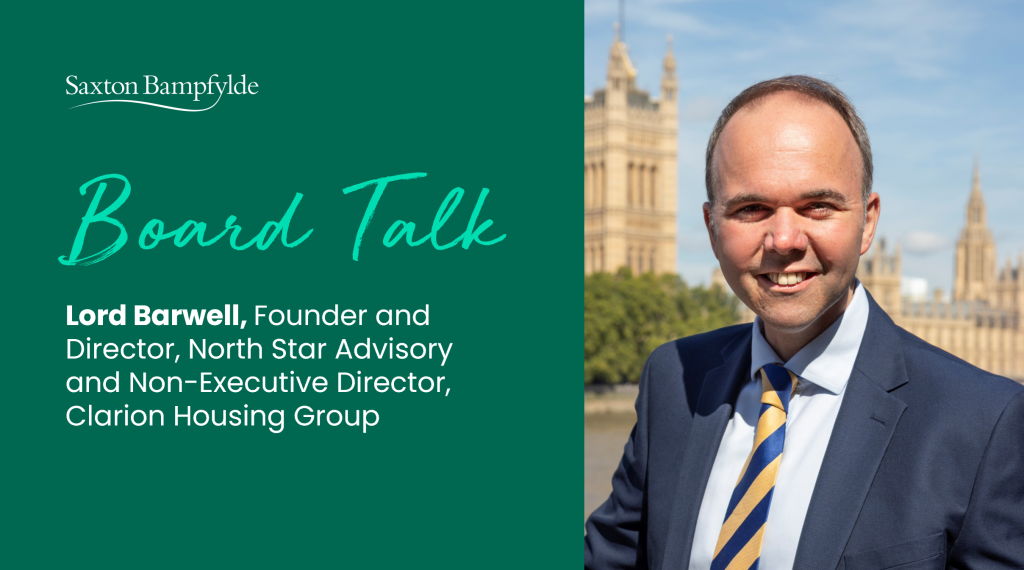
Through our work with boards across sectors, we consistently see the need for leaders who can help organisations navigate political and regulatory complexity. Lord Barwell represents exactly this type of strategic thinking – someone who understands how political decisions impact business and can guide leadership teams through uncertainty. In this Board Talk interview, he shares insights from his journey from MP to Chief of Staff to advisor and non-executive director.
We’re delighted that Lord Barwell shared his time and expertise with us, and we hope this conversation sparks your own thinking about leadership in our complex world.
“The world I came from as an MP is almost hard wired to constant tinkering and change, whereas the world that I now work in craves stability and predictability.”
You advise very senior leaders on how to make decisions in uncertain times. How did your experience as an MP shape your understanding of how political decisions impact businesses and other organisations now?
My appreciation and understanding of the challenges have been enhanced seeing it from both sides of the table. The world I came from as an MP is almost hard wired to constant tinkering and change, whereas the world that I now work in craves stability and predictability. There is a fundamental tension between the two. They don’t really understand each other very well. That is where I come in to create better connections and advise on approach.
This tension and difference in outlook are exemplified in two examples. The first sticks in my mind from when I started my business. At the end of one of my first meetings as an advisor with PWC, a CEO stated this view: “We’d rather a government had a bad policy and stuck with it for five years than change the policy five times and ended up with a good one.” This highlighted to me that while a business would always prefer good policy, what it really wants is stability to be able to make strategic decisions.
Whereas the world of politics is kind of hard wired into constant change, rather than stability. When I was at Number 10, I had oversight of the ‘Grid’. This is essentially a rolling programme of government announcements, aimed at driving regular positive stories about what the Government is doing. Those announcements mean constant changes in government policy; no change, no news.
Does the level of change we face currently feel too much, even for a political system ‘hardwired’ for change? This is an interesting point that has different considerations at a national and geopolitical level. Currently British politics feels more certain and predictable. We have a government with a big majority, unlikely to lose many votes over the next four years (although they seem to have managed to get themselves in a mess over welfare reform). The government I worked for under Theresa May didn’t have a parliamentary majority and every day was a battle to get support for what we wanted to do.
Conversely the geopolitical environment has become more and more uncertain, fuelled by specific mega trends and risks. I think Donald Trump’s re-election highlights this – it is an effect of the disrupted world. Inflation, mass migration and increased polarisation propelled him back into the White House and once there he becomes a magnified change agent. In other words, he is both effect and cause, not just the cause of the disruption we are experiencing.
“Often, [geopolitical threats] are treated as separate risks and they’re not; it’s a dynamic interacting system, creating a polycrisis world.”
In what felt an already fractured geopolitical environment, 2025 has brought even greater turbulence and uncertainty. What are the biggest geopolitical risks you are advising CEOs to be aware of today?
There are five mega geopolitical trends, as mentioned previously, that I would highlight. Each with equal and entwined importance.
Firstly, is a concept I term multipolarity, effectively power becoming more dispersed in the world. Fifty years ago, we had a bipolar world with the US versus the USSR. For the past four decades it has largely been a unipolar world with the United States as a seeming solo superpower; ‘Pax Americana’ if you like. That world is now gone, and while some suggest we’re back to a bipolar US versus China world, I think that simplifies the situation. We have India, Saudi Arabia, Brazil, Mexico, Indonesia, and even Europe not completely aligned with the US. Yes, the US and China are the two most powerful countries but there are others going to be strong enough to set the terms of trade in their own immediate environments.
The second is the rise of populism. In most democracies, mainstream parties are being challenged as never before by new players. In a few, mainstream parties have been taken over by populists from the inside.
Climate change is a geopolitical risk, as well as an environmental one. It’s a massive catalyst because of the issues it creates. Fresh water scarcity creates competition for resources; rising sea levels and temperatures drive migration and huge disruption.
Demography is a clear challenge, as there are still parts of the world growing very rapidly, like sub-Saharan Africa. This means feeding huge populations, finding employment and controlling disease and other health and social imperatives. In East Europe and East Asia there are countries in outright demographic decline. Each year they have fewer working age people to pay tax and more retired people needing healthcare and pensions.
And finally, there is technology. While ever present in human evolution, the speed of development and exposure has exploded. AI looking to develop superhuman intelligence artificially; quantum computing (if it comes about fully) will crack encryption with profound consequences for financial security, economics and geopolitics; and synthetic biology as the flipside of AI, where we introduce the artificial into biological systems to enhance them.
In my experience most boards are thinking about some or all of those things. Often, however they are treated as separate risks and they’re not; it’s a dynamic interacting system, creating a polycrisis world.
How do you advise companies to balance short-term political developments with long-term strategic planning?
From a short-term perspective, it is important to be looking at major elections, such as in the US last year, and considering what changes will be made. It is a kind of odds-picking approach, which means scenario planning for outcomes and mitigation tactics based on those odds.
In the longer term it is much harder to plan reliably when you look at the intersection of mega trends amplified by, and influencing, short-term outcomes.
To navigate these choppy waters, I talk to businesses about two areas. Firstly, a risk management function focused on scenario planning for individual events. And secondly emphasise the importance of trying to build a resilient culture as no one can predict everything. Even the greatest authorities and experts in the world don’t have all the answers.
If even Jake Sullivan, Biden’s former head of national security, with access to more intelligence than anyone on the planet who commented a week before the Hamas attack on Israel that “the situation in the Middle East looked quite stable” can get caught by surprise, then anyone can.
“The best boards are seeking to understand the macro environment in which their organisation is operating and considering the implications of that.”
What role should scenario planning and political awareness play in boardroom discussions? Has this shifted in recent years?
My starting point whenever I talk to a board is that paralysis to action is a route to failure. It is no good waiting for things to calm down – this changeable environment is not going away.
Even if the macro environment is unsettled it doesn’t mean that organisations can’t do very well. Even if it feels uncomfortable, having an appetite to navigate the choppiness, with good risk management and strong resilience, you are going to outperform your competitors.
A board needs to blend advice from people like me to understand the geopolitical context with their own, and external, sectoral expertise to answer the key question, which is “What does all this mean for us?” This is best done through discussion and sort of gaming through potential outcomes to create the most holistic and realistic approach to outcome planning for their individual organisations.
What advice would you give to Board members when choosing or undertaking non-executive roles in an uncertain environment, such as that we face currently?
The best boards are seeking to understand the macro environment in which their organisation is operating and considering the implications of that. That means bringing in a variety of expertise, often from external sectors, but there should always be a clear area of interest in the specific sector from non-executives choosing to join or already sitting on a board.
I wouldn’t expect most people on boards to have specific geopolitical expertise, but they absolutely do have to be interested in thinking about what the wider geopolitical environment means for that organisation.
What do you enjoy about being part of a Board?
I joined the Board of Clarion Housing Group in 2019. I did have experience as a previous Housing Minister and when I left politics and set up my business, I wanted to keep some connection with the world of housing. That was my motivation. As the largest Housing Association in the UK and a major house builder and investor in communities, Clarion has a key role to play in delivering the type of homes our country desperately needs. This role has only magnified my interest in this issue.
In my non-executive role, I have learned a huge amount and hopefully brought some useful skills to Clarion’s board to help better understand the political environment in which we’re operating.
The people I’ve served with come from a diverse range of backgrounds and I’ve learnt a lot from them, and I really recommend it to others. I find it a hugely fulfilling and learning experience and when my time comes to an end with Clarion, I want to find other NED roles to take on.
What gives you hope and what causes you concern about the UK’s place in the world over the next decade?
My hope comes more broadly about us as human beings, rather than looking at the UK specifically. As humans when we put our collective minds to something we can bring about big change. Look at what we did with the Covid vaccine, for example. In the UK during the pandemic, we effected more specific and rapid change from collective action building many emergency hospitals within weeks.
The difficulty we have today, due to social media and populism is the division it creates. It’s a very polarised world and makes it increasingly difficult to come to consensus of approach on many issues.
However, when the pressure really comes on and we’re forced to act to reach a consensus, we are capable of changing things very quickly.
(Lord) Gavin Barwell – Biography
Lord Barwell served as Downing Street Chief of Staff to Prime Minister Theresa May from June 2017 to July 2019 during one of the most turbulent periods in British political history. As the Prime Minister’s most senior political adviser, he was intimately involved in the conduct of the Brexit negotiations, as well as the development of key domestic policies like the UK’s commitment to net zero carbon emissions by 2050 and foreign policy (for example, the UK response to the attempted murder of Sergei Skripal by the Russian state).
Prior to his appointment as Chief of Staff, he was the Member of Parliament for Croydon Central from May 2010 until June 2017 and a Government Minister from October 2013 until June 2017 (initially a Whip and then Minister of State for Housing & Planning and Minister for London). Prior to his election to Parliament, he was the Chief Operating Officer of the Conservative Party and served as a local councillor in his home town of Croydon. In October 2019, he was appointed to the House of Lords.
Taken together, these roles have given him an unparalleled insight into British politics from grassroots campaigning in a marginal seat through party headquarters, local government, Parliament and Ministerial office to 10 Downing Street, as well as contacts in a number of foreign governments and the EU institutions.
He now runs NorthStar, a business he co-founded which provides advice on UK and geopolitics to clients including Arcadis, Barratt, Bute Energy, DLA Piper, Mace and PwC. He is also a non-executive director of Clarion Housing Group, the largest housing association in the country; and a member of the Advisory Board of the Work Foundation, the leading think tank focused on improving work in the UK.
He is a graduate of Trinity College, Cambridge with a BA in Natural Sciences.