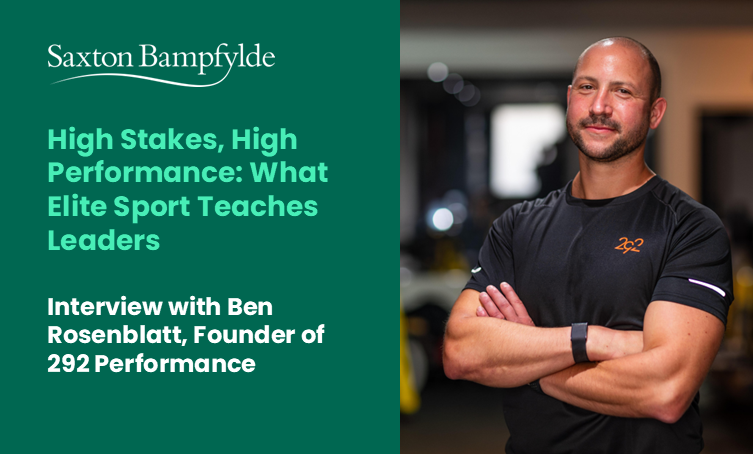
Performance coach Ben Rosenblatt, Founder of 292 Performance, has experienced the pressure cooker that is elite sport and shares with us the lessons that every leader needs to hear.
Having worked with over 1,000 athletes, including Premier League footballers and more than 200 world and Olympic medallists, Ben understand what high performance means. From Team GB’s gold medal-winning hockey squad to the England men’s football team, he’s operated where the margins are razor-thin and the stakes are highest.
In conversation with Kate Ludlow and Philip Rodney, Ben reveals what elite sport teaches us about performing when it matters most – making decisions under intense pressure and sustaining excellence over time. His insights aren’t theoretical – they’re battle-tested, evidence-based principles forged in the world’s most demanding performance environments. And they translate directly to the challenges facing today’s leaders: managing risk, leading through uncertainty, and delivering results when the pressure is on.
How do you help business leaders prepare for high-pressure moments?
The first step is understanding the performance demand by reverse engineering what the event will require. It’s not just the actual event—the speech or the pitch—but what comes before and after. Anyone can get through one big presentation; the question is whether they can do it again tomorrow, or cope when the phone rings at 2 a.m. because something has gone wrong.
You begin by mapping the demands: Where are your stretch points? Where will your time, energy and sleep be under most pressure? What can you change, and what simply has to be accepted? Having a clear plan can significantly reduce the psychological pressure.
In sport, one of the main tools is pressure training. A penalty is easy in training; the question is whether you can score in a World Cup final with millions watching. Pressure comes from judgement, expectation and consequence. When training people for genuinely high-pressure tasks, the important question is: how often do you rehearse in conditions that actually mirror those three elements?
There’s also a physiological side. Before a big pitch, what are you doing that makes you feel physically and psychologically strong? Are you laughing, lightening the mood, doing something that reminds you you’re good at what you do? Those small choices influence your physiology, your beliefs about yourself, and ultimately your behaviour under pressure.
Business leaders face constraints they cannot control—difficult boards, unforgiving markets. How do you help them focus on what they can influence?
Many of these constraints are actually knowable and manageable. When planning for major tournaments, we always started with a thorough situational analysis. The first question is: what is the demand we’re going to face?
With the England team, we recognised that a World Cup campaign over 28 days was the physical equivalent of playing the top six clubs seven times in a row, with three days’ rest between games. The first principle is knowing what the game is—what competition you’re actually entering. In sport, you can look at the calendar and identify the stretch points: high density of fixtures, higher injury risk, more travel, less sleep.
You can map the same thing in a company. You often know the periods when constraints will bite, and when demands will be at their highest. Once you have that insight, you can look ahead and say: “Next time, what are we going to do to stop that happening again?”
A genuinely competitive mindset pushes you to examine everything, starting with yourself. If you really want to win, you’re prepared to ask, “How was I part of the problem?” As a leader, that’s critical: identifying the challenges ahead, understanding the capacity and resources you have, and giving your team the best possible chance of success.
“You can detect subtle shifts in engagement, energy, or accountability if you have a regular, structured habit of review–preview–action.”
How do you identify the early warning signs that someone is heading towards trouble?
I’m very deliberate about this, and it comes from injury risk mitigation. In sport, there are several known risk factors for ACL (anterior cruciate ligament) injuries. You know that if an athlete is showing five or six specific markers, their risk is very high. I see leadership behaviour in a similar way.
One of the things we do weekly is a “review–preview–action” cycle for every athlete we work with. We’re very intentional about the information we capture: did they complete the training programme, what do the physical metrics say, what feedback do we have, what was their mood and energy? Then we preview: what do we expect to happen next week? Finally, we define actions: what are we going to do about it?
By following that simple but rigorous process, you can spot changes. In sport, around injury, you often hear, “He didn’t look quite right today,” or, “She’s been a bit sore, but it’s probably nothing.” If that gets ignored for three or four days, suddenly the athlete breaks down. The same applies in business. You can detect subtle shifts in engagement, energy, or accountability if you have a regular, structured habit of review–preview–action.
What made you realise that lessons from elite sport could transfer to business?
I’ve always been fascinated by principled thinking. My career has been different from most coaches: I’ve worked in rehabilitation with around 150 athletes from a wide variety of sports. That pushed me to look for the higher order principles—what is universally important for all athletes, regardless of the sport?
The common thread is performance itself. Whether it’s an athlete preparing over years to win something, a military unit preparing for an operation, or a business leader making high-stakes decisions with limited information, the core challenges are similar. It’s about how you prepare for those moments, how you deliver in them, and how you recover so you can go again. That performance lifecycle is the shared pattern; the context is what changes.
That need for structured, evidence-based performance support applies equally in business.
When you approach performance with rigour behind belief, you move from ‘believing’ to simply doing.”
Can you share an example of a transformation that shaped how you think about human potential?
For me, it’s about a group or an individual genuinely believing in what is possible, and then building the evidence to support that belief. Saying “I can do it” is easy. The hard part is asking: if I truly believe this, what does that demand of me?
One example is a heavyweight judo fighter. She was European champion and one of the top fighters in the world, but every time she went to the Olympics she was knocked out in the first round. Three Olympics, three first-round exits.
For the fourth Olympics, her coach and I set out to create an environment that gave her hard evidence she could succeed. A year out, we sent her to a training camp and deliberately put her into the most uncomfortable possible situation. She hated it. At the World Championships, she finished fifth—disappointed, but qualified for the Olympics.
Next cycle, we sent her back to the same camp, but this time we flipped the experience. She fought to her strengths, had more support, and saw that a different approach could produce a different outcome. Her belief in what was possible had shifted. She went on to win bronze at London 2012.
When you approach performance with rigour behind belief, you move from “believing” to simply doing. At that point, the transformation has happened—and people find themselves a long way from where they started, almost without realising how far they’ve come.