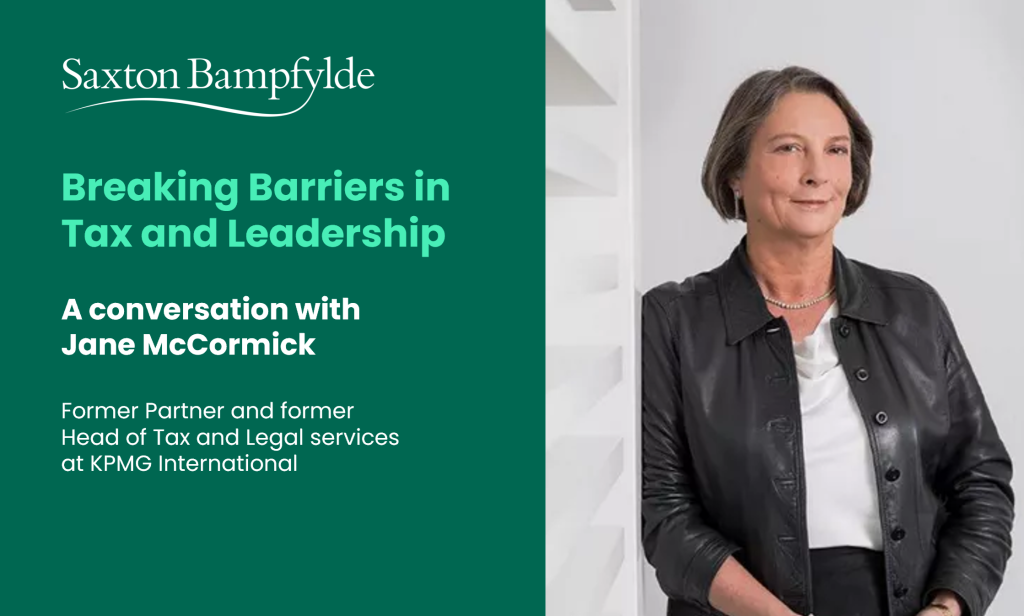
To celebrate International Women’s Day, we’re delighted to speak with Jane McCormick, a leader whose remarkable career has helped redefine the landscape of global tax and legal services. With over 30 years of experience in an industry where expertise and influence rarely come easily, Jane has held some of the most senior roles at KPMG, including Global Head of Tax and Legal Services, Head of Tax and Pensions in the UK, and Head of Tax for Europe, the Middle East, and Africa.
You’ve spent much of your career in professional services. What feels distinct about leading and influencing highly autonomous professionals, and how should law firm leaders and boards adapt to that reality?
In professional services, particularly in partnerships where partners are co-owners, people genuinely run their own piece of the business and are true experts in their fields. Just because you are their boss does not mean you know more than they do.
Leadership is not command-and-control; it is about negotiation, persuasion and reaching joint solutions, which demands extensive internal consultation. Respect is critical, especially for leaders coming in from outside, who need to demonstrate that they can manage major client relationships and understand technical issues, while also bringing a commercial overlay.
Many professionals, not just lawyers but also consultants and accountants, have limited commercial training in business building and running an organisation, so emerging leaders must educate themselves and their teams as they progress. I also had to recognise that growing up in the business did not mean I had all the skills to run it, and that I needed external guidance and help.
Over the course of your career, has the requirement for consultation increased, and how does that sit alongside changing expectations of governance and board responsibility?
External expectations of professional organisations have risen markedly, both from clients and regulators. Governance requirements do not always sit comfortably with collegiate partnership structures, and it can be difficult to reconcile those demands.
Those charged with governance often carry significant responsibility without equivalent concentrated power, which remains widely diffused across the organisation. Managing that tension is now a central challenge for professional services leaders and boards.
You led KPMG’s Global Tax and Legal Services practice globally. How has that experience shaped the perspective you bring to a law firm board?
Tax and legal were not fundamentally different from a law firm; it was essentially like running an international law firm, but with added complexity. We dealt with hundreds of regulators, and many national practices were regulated by multiple bodies in a single country, overlaid with a demanding global regulatory environment.
I used to say that doing strategy in KPMG or any big firm is not like captaining a single tanker but guiding a flotilla of ships. That experience translates well to law firms, because even in smaller firms, different specialisms have distinct dynamics, clients and economics, and need some autonomy in setting their own strategy. The challenge is to pull those strands together into a coherent whole so that choices about what you do and, importantly, what you do not do create a strategy that makes the organisation more than the sum of its parts.
As you look ahead 5 to 10 years, what will differentiate successful law firms?
Scale will matter, particularly for firms serving the business market rather than retail clients. Clients’ expectations are rising: they want deep expertise by subject matter or sector, and the era of the generalist is largely over. That requires critical mass to offer sufficient depth across chosen areas, which is driving consolidation.
Not every firm can be “magic circle” and cover everything, so firms below that level will need to make clear strategic choices about sectors and capabilities where they build real depth.
Technology will be the other major differentiator. Clients are no longer willing to pay hourly rates for routine tasks; they expect automation and outcome-based pricing. AI is part of this, but the technology agenda is broader: process automation, effective document management and robust data security, especially as law firms have historically been seen as the weak point in the information security chain.
Firms will need to invest heavily in technology and, crucially, in the people and processes around it. Those that spend wisely and integrate technology into how they work, rather than just buying tools, will succeed – and again, scale helps because technology is expensive.
How can law firms best balance the decline of the traditional generalist model with clients’ continuing desire for a single senior point of contact who can advise across issues and coordinate specialist input, and to what extent does the partnership structure support or hinder this?
In accounting, we developed sophisticated client relationship management earlier, particularly around audit relationships, where the audit partner used to choreograph the whole firm for the client. Regulation has changed that, so we had to relearn those skills in other parts of the business.
What matters is developing “Tshaped” advisers: people with deep expertise in one area who, as they become more senior, can talk across the piece with clients. Late in my tax career, I rarely provided detailed technical tax advice because I could not keep up with constantly changing law, but clients still valued my judgment on what I would do in their position.
Clients want that kind of holistic advice, plus the confidence that you can mobilise the right technical teams and organise the firm around their needs. Some lawyers excel at this, but those client relationship skills are still not as widespread across the legal profession as they need to be.
Turning to your non-executive roles, are there things you wish you had understood about board dynamics when you were an executive that you see more clearly now?
As an executive, it is easy to think, “Who are these people asking me these questions? I know this job inside out.” But executives and non-executives simply see different things. Executives look at issues through a microscope; boards look through a telescope.
I have experienced both perspectives: as an executive, having a board member ask a question that revealed something I had not considered, and as a non-executive, seeing an obvious point from afar that the executive team had missed. Valuing that difference in perspective is critical, and many people in day-to-day roles underestimate just how valuable it is.
How has that shaped the way you support your executive leaders now?
I now spend more time as a chair than as a pure non-executive, often chairing boards or audit and risk committees. The style I find most effective is very similar to managing in a professional services firm: it is quasi-coaching and mentoring.
Rather than being directive, I focus on asking questions and helping executives think differently, so their conclusions evolve through the conversation. I may have a clear view on what I think should happen, but instead of saying “we should do this”, I ask “why are we doing that?”
I have worked with board members who are too prescriptive, and that approach rarely works. What does work is taking time to talk things through and arriving at a collective view, rather than two entrenched positions being argued out. That is especially important when some board members come from corporate backgrounds and need help understanding the boundary between board oversight and executive management in a partnership style environment.
What have you learned about choosing the right roles for you? What criteria do you apply?
First, the subject has to genuinely interest me. For example, I initially resisted a hospital role because I had no healthcare background, but the organisation specialises in neuro disability, which connects to my psychology degree and longstanding interest in brain function, so it became compelling.
When I left KPMG, I assumed my board career would focus on large financial services organisations, but I have gravitated more towards professional services and smaller businesses. I have found I enjoy organisations that are big enough to have complexity and heft, but small enough that I can make a real difference.
I have also learned that my ability to help set strategy is not specific to tax and legal. It is about being good at strategic thinking, helping others work through their strategic choices and gather the information they need at the right level. The key question for me now is whether I can contribute to how an organisation succeeds and becomes sustainable for the future – that is what I most enjoy.