
Creativity and innovation are terms that are frequently thrown about when organisations are discussing change and development. But how often do leaders take a proper step back and consider what really needs to be done to support their employees, their most important assets, to think more creatively and come up with innovative solutions? Too often, suggests Dr Mark Batey, a thinker and practitioner in creativity and innovation, the focus is on the end result rather than the creative process of solution-finding.
We heard from Mark at our latest leadership breakfast, during which he explored the ways in which HR leaders have a role to play in stimulating a culture of innovation and creativity.
Mark highlighted the importance of organisations investing properly in their people, right from the start of the recruitment process, at induction, and throughout their time with an organisation. He talked passionately about the importance of looking at people, rather than jumping too quickly to technological solutions.
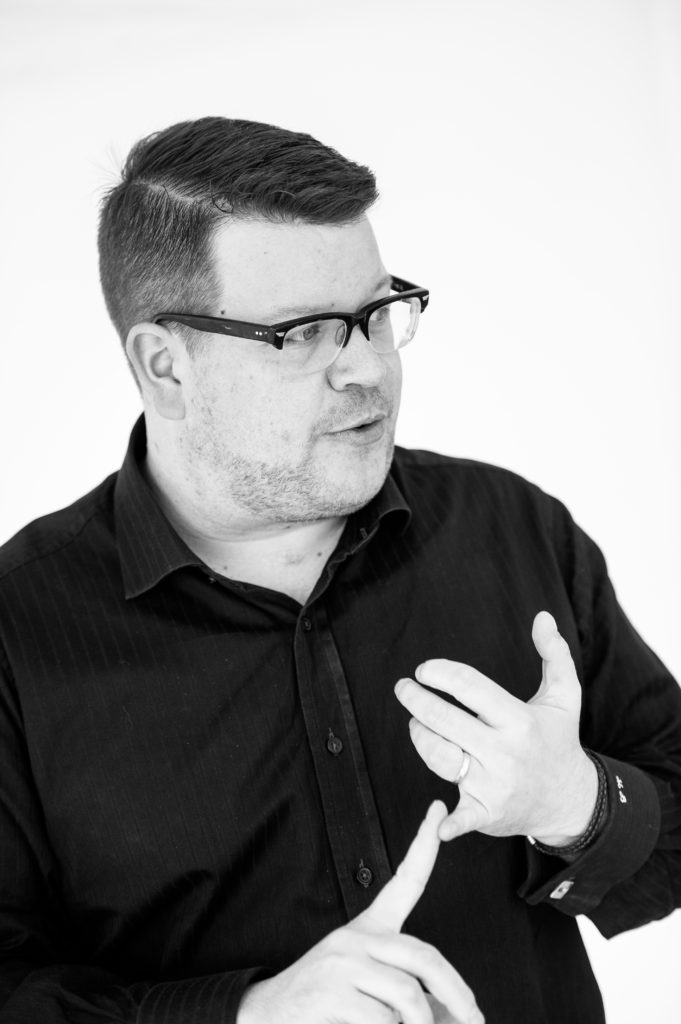
Mark, can you share a little bit of your background for our readers?
I am a father of three with a long-suffering wife and a great enjoyment of all things cooking, music and singing. I tell you this first as I think it is really important that we embrace humanity at work. A really big part of this is recognising, first and foremost, that we are all real human beings.
From a career perspective, I am an academic practitioner in innovation, creativity and leadership. I have conducted a large number of research studies on everything from individual creativity and innovation, through to better understanding regional cultures, and how to lead and manage creativity and innovation across different global contexts.
That is the academic side. I am based at Manchester Business School and while I did my PhD part time I also consulted for the likes of Simon Cowell and others. I have a deep history of working with everything from nanotech start-ups to Fortune 500 companies, coaching individuals, developing teams and helping organisations to conceive new products, services and processes. Basically all of the elements you would expect from a ‘creativity and innovation person’ – essentially helping people create stuff. My latest area of interest is around shaping cultures and building a creative organisation.
Is your area of academia particularly niche?
My area is pretty niche, but there are a small number of people with similar research interests and backgrounds.
However, there are very, very few people who have done the research and then gone on to apply it. That does make me virtually unique in that I haven’t identified many researchers who then apply their findings, or equally many practitioners who do the research.
Creativity and innovation are two terms that are often used interchangeably – what do they mean to you?
I am going to steal a quote from Edison who said: “Genius is 99 per cent perspiration and 1 per cent inspiration”. Creativity is the inspiration part: it is the mindset, thinking and attitude to try to develop new ideas that help you solve problems and help you take advantage of opportunities. Innovation is the application, the perspiration in that dynamic. It is where you take the great ideas and develop them and become more and more serious with them, to the point where you introduce a new product, service, process or concept that brings value in some way to the world.
The really important thing about the two different words here is that most organisations really just want the new practical innovation, the product, new model or service, or to improve processes at work. They focus on the end game without building the right conditions in which people are comfortable and supported to be creative. The ideas have to come first and that is often ignored, which is where the greatest problems lie.
Creativity is about thinking about new ways of doing things and we need that in every aspect of work at every level.
Why do you believe more organisations are placing an increased emphasis on creativity and innovation? Is this important at both organisational and individual level?
I am going to borrow another quote here: Heraclitus in c. 500 BC said: “The only constant in life is change”. The only thing that stays the same is that everything changes. If you are still doing what you did last week, the chances are that your organisation will become obsolete. If you as an individual are still doing the same things, the chances are that your skillset will probably end up falling out of fashion. If our consumers, technology, the economy and the physical environment are constantly changing, organisations need to adapt and change too. Creativity and innovation at work are at the heart of this agility, change and renewal.
In terms of organisations placing emphasis on creativity and innovation, it really varies. I think there are those who genuinely understand the need to be creative and innovative and have built it in as part of their DNA. Most of the time, these are organisations that were set up with this in mind, such as Google, Apple, and those types of business. They were always designed to be innovative companies.
Likewise, most new start-ups round the world are taking advantage of new technologies and they have set out with creativity and innovation at their heart.
The harder task is for the organisations that need to go through a cultural transformation and move away from an original mantra based around efficiency and security. One example of this is that I do a lot of work in financial services and particularly in the insurance industry. They are finding it reasonably tough, as an old industry with over 100 years’ practice and custom, to start thinking about ripping up the rule book and beginning to think and act differently.
There are those who genuinely get it and encourage their organisations to go through transformation and there are some excellent examples of that. However, there are those who pay lip service to creativity and innovation. In these cases, it might be incorporated into the mission, vision and values or added into the competency framework. It is as if they expect a magic trickle-down effect, just by adding the words ‘creativity and innovation’ into their company collateral. I find that without the right culture and supporting practices and processes, that trickle down never works. You actually have to have skin in the game and make it part of the DNA.
In your experience, what are the most frequent organisational blockers to innovation and creativity?
If you do not actively promote the idea that everyone at every level throughout the organisation needs to be a little bit creative and innovative in their day job then people just regress back to a mean. If one is just struggling to get on with the day-to-day, embracing creativity and innovation is very challenging. Research shows that the number one driver of creativity and innovation is when the staff realise that being creative at work is part of their job description and that it is absolutely what their senior leaders are looking for.
Other blockers that have been clearly identified through research include: the existence of a blame culture; highly risk averse approaches; and incredibly hierarchical organisations with top down processes that don’t set the conditions to encourage great ideas.
When you consider the function of HR in this context, what role does it play?
I think HR plays a vital role and is absolutely central in establishing organisations where people are able to be creative. HR staff are able to set the right kind of systems in the workplace. If that system is about driving creativity and finding people who are supported to think well, and the innovation is about creating the environment where the ideas can be applied to bring about value, then a strong HR function is fundamental and has many roles.
This includes getting the right people in through the door and better identifying how the employee value proposition is set up. If companies are looking for the best employees with the right attitude and skills, HR is vital in the attraction and recruitment of those people. In the induction process, where there is a proper framing and scene-setting for new staff which makes it clear the reason they have been employed is to help the organisation do things better and differently – that is where HR must play a key part. It is at the heart of the management and identification of performance and development of staff. If people need to learn and develop creative skills, then the training must be under the aegis of HR.
I would also go further and look at the organisational structure, and ask a number of questions about staff. What are they being rewarded for? How is their performance measured? How are they included in decision making processes? How are teams resourced so there is a diverse range of skills? How do you structure the overall organisation so different departments are able to bounce off one another and leverage their different skills?
HR is absolutely at the heart of all of this, and if it has a proper seat at the top table then it is part of the leadership culture that shapes the overall feeling of an organisation. There are some great examples of this: companies such as Netflix, Facebook and Google pay a huge amount of attention to the soft side and what it is like to work for their respective companies. I am finding that more and more organisations are recognising that if they want to have happy customers, they need to have happy employees who can ensure that they are engaged, committed and responsive to customer needs.
There are those that are beginning to get it and who recognise that virtually everything that happens of value in most organisations is done by human beings. If you are leaving human beings as a bit of an afterthought and not investing in them, it doesn’t seem very sensible. In most organisations, humans are far and away the largest cost in a business. Yet few companies apply the same level of attention to human systems as they do to IT systems.
What are the key enablers which allow an organisation to foster creativity and innovation?
I would encourage organisations to think of the approach to creativity and innovation as a system. Where organisations think of these elements as a quick fix or a general panacea, they will fail. Suggestions such as hiring really creative people, setting up a reward scheme or a staff suggestion box in isolation are not going to make any difference. If the other processes or systems within an organisation are not aligned, then it will not work. I prefer to think about individuals, teams and organisational processes and culture, with leadership as the glue that binds those three together. At the individual level, it is about the HR side of things: the recruitment, attraction, induction, development and training, all of which are so important. At the team level, it is about bringing together a diverse group of people in a safe and inclusive environment where they feel comfortable working together. At the organisational level it is the structure as a whole that must allow the leveraging of different skills and functions, without ending up with everything siloed. It is important also to think about an innovation strategy and how much risk is being put into the system. There needs to be an opportunity for an organisation to think with three different points of emphasis for innovation. The first of these is to be more ‘out there’ and completely revolutionary; the second is to stretch and think about how things could be changed pretty dramatically; and the third is to look at how the day-to-day could be changed incrementally. The key is finding a sustainable balance between revolution, stretch and incremental innovations.
Finally, leaders are integral in bringing all this together. It relies on those people who recruit, manage, reward, encourage or crush creativity, put teams together and ultimately set the organisation’s vision and strategy.
Truly thriving organisations recognise the importance of the whole system and start to align individuals, teams and organisations within it.
Are there any particular tools or technological advancements that organisations are using successfully to drive this?
Against the backdrop of the rise of automation and more intelligent systems that will be doing more of the mundane work for us in the future, we really should be thinking about where we are going to extract the greatest value and pleasure from our humanity at work. What is going to make people happy and engaged and where they will bring the most value. I believe very squarely that the two things we are going to be doing in the future are creating and emoting. What we are better at than machines is thinking outside the box, being unusual in our thought processes and we are definitely better at emotions than machines. We should be focusing on those kinds of skills and encouraging that kind of thinking.
I think technology changes all the time and yes, it is important, but I think the greatest investment is still in humans. They spot the opportunities and develop the innovations. Before any organisation spends a huge amount on technology and technical systems they need to establish if they have invested enough in employees, encouraged them to be creative, spent time training them to have better ideas, and have leaders with the skills to build a creative and innovative culture.
Can you highlight any organisational leaders or organisations that stand out as leading examples in this area?
If you want to see organisations at the cutting edge of creativity and innovation go to a small start-up – that is where you will find most people melding their experiences together. No idea is off the table, there is a lot of enthusiasm and a really flowing, organic kind of structure.
What I am very respectful of are those who are trying to keep their heritage and history whilst pulling themselves into the 21st Century. Mont Blanc seems to be doing some very interesting product innovation at the moment, including pens and watches that can now be connected to smart phones and digital notebooks. It is not losing sight of where the business comes from but is modernising creatively.
A great example of business model innovation is an organisation like Airbnb, which has turned the entire hotel industry on its head and doesn’t even own one hotel. Similarly, Uber which is effectively the largest taxi company in the world, despite not owning a single taxi.
For me, deep down the leaders I respect more than any others are those that are creating and innovating but with a social conscience at the same time. I think of those who are trying to set themselves up in the more than profit sector and using really clever technologies to do so. I worked recently with a charity that is helping farmers in Africa grow much better crops by giving them text message data about weather and agricultural advice. In some parts of Africa, you have more access to a mobile phone than you do to clean water and there are ways that you can use modern technology a lot better.
One of the most interesting approaches to stimulate this sort of thinking is Jugaad Innovation. It is an Indian word meaning ‘frugal’ and I think in many ways you can find some of the most innovative ideas from people who have the least resources. These individuals can be an inspiration to us all. In fact, I believe that Nissan and Renault send some of their leading engineers to India to understand how people can innovate and make successful products with very basic materials. It has reportedly saved them a fortune by getting them to think how frugal developers in innovating countries think. I am intrigued by companies that are taking this method and approach and implementing it in their own businesses with great success.
A last thought: without deliberate effort, individuals, teams and organisations soon focus entirely on the day job. What are you doing in your company to promote creativity and innovation?
Biography
Dr Mark Batey is a thinker and practitioner in creativity and innovation, combining leading-edge academic insight, with international experience as a speaker, consultant, delivering keynotes, workshops, training and more. From Simon Cowell, to Gogglebox, to advising governments.
Mark is widely published on the subject of creativity and is associate editor of the International Journal of Creativity and Problem Solving and an editorial board member for the APA Journal Psychology of Aesthetics, Creativity and the Arts. He is one of the most published researchers in creativity of recent years. Mark has featured in outlets including the BBC, Financial Times, The Times, The Guardian, and the Wall Street Journal. He has worked with organisations that include AB InBev, Bank of America, Bao Steel, BBC, BP, Channel 4, JC Decaux, Johnson & Johnson, NHS, Rolls-Royce, Sony Music Entertainment, Tesco, Thales, Zain and Zurich.
If there are leadership challenges your organisation faces which we can support you with, we would be delighted to discuss them with you and with one of our Leadership Services team: https://www.saxbam.com/services
Biography
Dr Mark Batey is a thinker and practitioner in creativity and innovation, combining leading-edge academic insight, with international experience as a speaker, consultant, coach and facilitator. Delivering keynotes, workshops, training and more. From Simon Cowell, to Gogglebox, to advising governments.
Mark is widely published on the subject of creativity and is associate editor of the International Journal of Creativity and Problem Solving and an editorial board member for the APA Journal Psychology of Aesthetics, Creativity and the Arts. He is one of the most published researchers in creativity of recent years. Mark has featured in outlets including the BBC, Financial Times, The Times, The Guardian, and the Wall Street Journal. He has worked with organisations that include AB InBev, Bank of America, Bao Steel, BBC, BP, Channel 4, JC Decaux, Johnson & Johnson, NHS, Rolls-Royce, Sony Music Entertainment, Tesco, Thales, Zain and Zurich.
Saxton Bampfylde Leadership Services
If there are leadership challenges your organisation faces which Saxton Bampfylde can support you with, we would be delighted to discuss them with you and with one of our Leadership Services team: contact@saxbam.com