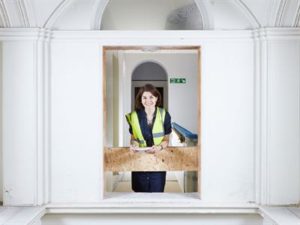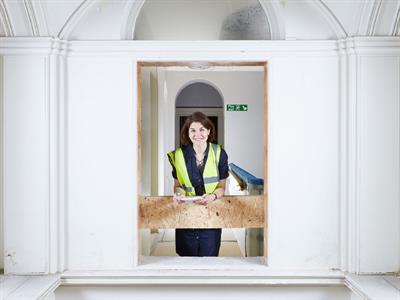
With the restoration of the former home of Sir John Soane, Pitzhanger Manor, and its adjoining new Gallery, scheduled for later this year, we have been given an early glimpse of what we can expect from Director Clare Gough. She shares her perspective and passion about a project that has exceeded all her expectations and looks ahead at why and how an arts venue can and must make connections locally and further afield.
As we talk you are entering the final stages of completing the restoration of Pitzhanger Manor & Gallery. With that in mind can you give us a bit of an overview of what we will be able to experience when it reopens in late 2018?
Our guiding principle for this project has been to transport Pitzhanger Manor back to how it was when Sir John Soane himself lived there between 1800 and 1810. But that in itself has been quite tricky as Soane was certainly a man who changed his mind and adapted spaces regularly.
We believe it will be really exciting for visitors to experience a beautiful manor house, set in its estate, which Soane designed, built and lived in himself restored to how it was in his time. When you are upstairs in this beautiful house, as it was in 1800, it really is very hard to believe that you are in London. The park is so pretty and surrounded by trees, it is remarkable to conceive that this was once a country estate now sitting in a truly global city.
Immediately adjacent to Pitzhanger Manor, in what formerly was Ealing’s lending library, we are creating a stunning contemporary exhibition gallery. Separate to the house, it offers us the opportunity to respond to Soane and his inspirations and ideas through works from other artists, architects and contemporary designers. We have conceived this conversation-style approach with Soane and his house on one side and the response from contemporary creatives to his ideas and work on the other.
At the far side of the house, in what was the kitchen garden, we are building a fabulous café to revive our visitors after they have walked around the house and gallery. This will also provide an essential revenue stream for us in the future.
The experience of Pitzhanger we hope will be wide and varied beyond visitors to the house and gallery through a programme of private and ticketed events. This will allow us to open up Pitzhanger to wider audiences; be much more inclusive and accessible; and on a more practical note, will provide vital income.
What do you believe makes Pitzhanger special?
What really stands out to me is the combination of the historic with the contemporary in an absolutely stunning setting. It is a very exciting example of a house that was designed 200 years ago sitting in its original parkland, with a new, contemporary gallery sitting next to it to take the opportunity and space to reflect on what Soane means to us today.
We are planning to put artworks in the house itself and are talking to contemporary artists about pieces that respond very specifically to individual rooms. The separate gallery will provide a space for reflection when visitors come out of the house to see how Soane has inspired other artists.
Soane himself was so contemporary and inspirational to future architects. His own collection was so varied, ranging from the ancient Greek through to contemporary items and works of Hogarth, who lived around the same time. We are continuing his legacy by doing what we believe he would have been doing himself with these collections were he alive today.
You took on the Director role in 2016. Can you outline what attracted you to the role, and what it has involved since you have taken up position. Has it evolved from what you imagined when you began?
Not many people are given the chance to set up an arts venue virtually from scratch, and it was this hugely exciting and immensely challenging opportunity which appealed to me most.
I was very attracted by the opportunity to set up the ethos of the team that would be working here. I was keen to combine my varied previous roles to bring my commercial background together with my experience of working in the museum sector. The commercial side is so important to making Pitzhanger successful to allow us to do all the challenging things we want to do and put on the exhibitions which we want to. This is really where some arts organisations struggle, finding a tension between the commercial and the creative. I was excited about the opportunity to create an ethos where both are recognised for the importance that they bring to the whole. Commercial creativity and entrepreneurialism are absolutely encouraged across the team, and our curator will sit down with the commercial director to discuss how they can extend their respective work into the other’s area to get the very best from, and for, Pitzhanger.
I have to admit that I didn’t know about Pitzhanger Manor before I was approached for the job. I really find it astonishing that there was this home of Soane that I wasn’t aware of. They are so many Soane lovers and most of them don’t realise that Pitzhanger exists. It is so under the radar and has such potential. To bring this real gem back to life and into the heart of the community just is such a unique opportunity and one that I am so passionate and excited about on a daily basis.
With a project such as this what have been the highlights for you so far?
Every day my job brings absolute highs and crashing lows. Joys of seeing new work being unveiled and lows when you realise there are things that you want to do but can’t.
The real excitement undoubtedly comes from revelations in the building. One of the most vivid for me was the day they reinstalled beautiful carved roundels into the façade of the building. This was the first time in 150 years that the house was looking at it from the back view.
What has really made this particular experience so transformational for me was the journey of these roundels. I had gone to the workshop where they were being produced by a team of really young stone carvers. The excitement of seeing young craftsmen being engaged in work that Soane himself would have enthused about was so inspiring. I then saw them being delivered and installed on the façade and it was a truly special moment.
I had a similar moment inside the Gallery with the removal of the artificial roof which was covering skylights built in the 1930s in homage to Soane. The day the scaffolding came down there was an almost magical flooding of the room with natural light. It was a really exhilarating experience.
I still also love watching how people engage with the house, watching them get excited, even with dust and diggers all around. There is so much this house can and will be, and that brings a wonderful feeling of anticipation for me and many others who have experienced it so far.
On the flip side what have been the key challenges you have faced and also some of the learnings?
Ultimately the key challenges were operating on a tight budget and a short timescale. Our aspirations and ambitions of what we could achieve go far beyond the timeline we have, and the budget.
If considering it differently and identifying learnings, I would have reviewed the timing and the structure of the project, taking more time to consider the approach before we embarked upon it.
The involvement of the Pitzhanger Manor & Gallery Trust at an earlier stage could have allowed more input into the project briefs that could have helped some elements to run more smoothly. That is not always easy, or even possible, to do but it is a learning to be taken from the project.
What would you highlight as the key motivators for engaging audiences – public, private, stakeholders – with a public arts venue?
For me there are two very important elements. Firstly, to deliver real and honest engagement with a diverse public requires a very effective and well thought through outreach programme. Secondly, and parallel to that, is the quality of the offering at the venue.
Obviously different emphasis comes from each of these depending on the stakeholders with which one is engaging, but it is important to get it right, make it effective, and the approach needs to be adapted accordingly. We need to ensure we are really reaching the people we want to reach, not just seeing communications and engagement as box-ticking exercises.
Looking more broadly at the sector, do you believe there are opportunities to engage a wider range of society in the arts overall? Is enough being done to make cultural venues and destinations accessible?
There are always opportunities to engage at a wider level. The sector itself has made huge strides in the past but there is still a long way to go. One of the key measures of an organisation’s outreach success is in who comes to visit it and its exhibitions, as opposed to what is taken out to schools and other organisations.
When one goes to most arts venues it is still evident that typical visitors are mostly a small subset of society. Each organisation, and the sector more broadly, needs to make sure the outreach is so effective that every area of society chooses to come.
With regards to physical access I believe the sector has made strong advances in this area. I am delighted to say that Pitzhanger will be as physically accessible as possible. We can’t take people into the attics, but all other areas will be accessible.
Fundamentally one of the main drivers for Pitzhanger is to create a thriving arts centre in West London, which has traditionally been underserved in the past. We have to really focus on engaging local, national and international audiences, and this is very much a driving force for what we are trying to do.
Finally, what are your hopes and aspirations for Pitzhanger Manor & Gallery in the next five years?
I really hope and want Pitzhanger to be a destination that people know. I would like them to view it as an exciting, challenging and fun place to visit. It would be fabulous if it was up there on the ‘places to visit at the weekend in London’ list and to be recommended to visitors. If we can achieve this then it will be clear that we have truly succeeded in our aspirations to engage a diverse and expanding audience.
However, to make this possible there is another necessary goal and that is to ensure financial stability. This would then offer us the capacity to continue to experiment and broaden our outreach and pursue some of the more exciting and slightly more challenging programmes we have already identified on our wish list.
CLARE GOUGH BIOGRAPHY
Clare Gough is Director of Pitzhanger Manor & Gallery, Sir John Soane’s country home in west London, currently undergoing a major HLF and ACE-supported conservation and renewal project: she is responsible for all aspects of the operation of Pitzhanger following its reopening to the public, from its exhibition, education and outreach programme to the retail operations essential to support these activities.
Clare was Director of Communications at the National Gallery, and prior to that New Media Director at National Gallery Co. Ltd, before setting up her own arts and media consultancy. In this role she pioneered taking arts exhibitions live to the cinema, including David Bowie is for the V&A and Leonardo Live for the National Gallery. Clare started her career in the commercial sector as a management consultant.
www.pitzhanger.org.uk