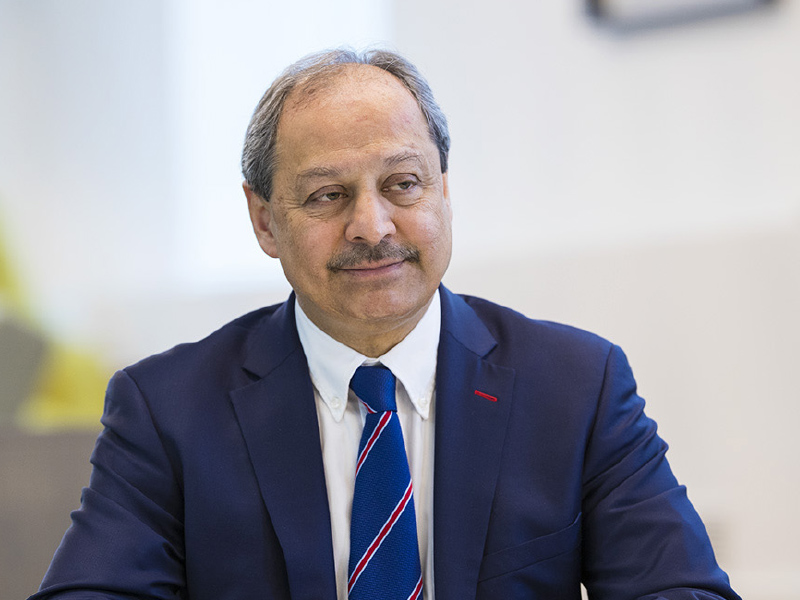
Interview with Dipesh Shah OBE, Chair of the Notting Hill Genesis and Notting Hill Home Ownership Boards
Having guided the merger of Genesis and Notting Hill Housing Associations, we join Dipesh Shah, now Chair of the Notting Hill Genesis and Notting Hill Home Ownership Boards, to reflect on the process and his hopes for the industry’s future.
A hugely experienced Chair across a number of sectors, we talk to Dipesh about the challenge of taking on his first role in a housing association and having to guide a complex network of stakeholders through the merger process. Dipesh shares his thoughts on the need for good governance to reflect the ways in which the sector has changed over recent years and discusses the need to elevate social housing within the housing debate.
In April you and your colleagues concluded the merger of Genesis and Notting Hill Housing Associations. What key advice might you give to other boards considering or going through a merger?
Mergers are time consuming. They inevitably create a great deal of uncertainty and insecurity, so it is important to address the most contentious issues at the outset to see whether they can be resolved before one goes too far down the road. For us, that meant establishing clarity around why we are looking to merge and agreeing on some particularly important principles on which the merger would be based.
The question of why we should merge was considered carefully between the two CEOs and Chairs within a week of my joining. There were a number of drivers, including the advantage of scale when it came to being around the top table and helping shape policy, but – critically – we saw that a merger would be facilitated by the common heritage of the two organisations in support of our residents. Soon after that initial meeting, I set out the key founding principles of the merger to ensure we had common ground.
One of the most important of these was that this would be a merger of equals. It was agreed that we would go through due process to reflect this principle in terms of the board composition; there would be equal numbers from both organisations on the board, and the senior cadre would be represented equally in terms of the executive directors, as well as the tier below that.
Another important principle we established was to recognise that not everyone would be able to, or indeed want to, be part of the journey. It was agreed that those staff would be treated fairly and with respect as after all they hadn’t asked to be involved in a merger.
We enshrined these principles at the outset of the negotiations, and I’m pleased that that we ultimately implemented each of them.
The final element for me was a recognition that the process had to start with a campaign to win the trust, hearts and minds of all our stakeholders. I reminded my colleagues continuously along the way that, if the organisation was to truly succeed post-merger, it needed to carry that trust and conviction into the process beyond. And that was precisely what we did.
With pressure growing on the UK’s housing providers – and especially housing associations – what do you feel is the greatest challenge faced collectively by the sector’s leaders?
In recent times, society has become increasingly polarised and there is widespread recognition of the challenge around inequality. Post-Grenfell, local activism has intensified, enabled by the ease of communication through social media. As leaders in social housing we need to grasp these trends. We can do so through an active engagement with our residents and by putting structures in place that allow this engagement to happen continuously.
As a nation, we are in the midst of uncertain times, economically, socially and politically. The provision of social housing is in the eye of the storm and the model employed over recent years, whereby the development of market sales and rentals is used to fund social housing, is likely to be strained. This model can continue for existing schemes but eventually something will have to give. We will need to work with all interested parties to establish a new agreement on how additional social housing is to be provided, and how it is to be made affordable. To do this, we need to elevate the role of social housing within the housing debate. We must also be innovative, and we will need to embrace new technologies and the digital revolution to establish new ways of doing things.
What leadership qualities at board level do you think are most needed to meet the challenges and opportunities facing the housing sector?
Let me start with something that is blindingly obvious but well worth repeating. In leaders we must first and foremost look for a deep-seated empathy with the social purpose. I wager that this will be called on more and more.
Next on my list is peripheral vision. With the changing societal, economic and political landscape, boards of social housing organisations will need increasingly to be strategically adept, agile and forward-looking, not least in embracing digital and technological innovation. The ability to communicate and take people along will also be critical.
Boards will need to make some difficult choices while adhering to their social purpose. Being able to articulate these choices clearly, and to take stakeholders along on the journey, will be pivotal to success.
“In leaders we must first and foremost look for a deep-seated empathy with the social purpose.”
How do you see the governance requirements of the housing providers evolving in light of how the sector is changing?
This is critical. Most social housing organisations have well tried and tested governance models. There are, however, two areas where increased scrutiny and emphasis is likely to be required as we advance into the future.
Firstly, there is the question of how we further embed resident engagement, so that it becomes a part of the fabric of the organisation. Notting Hill Genesis provides homes for around 170,000 residents; equivalent to about half the population living in the heart of the city of Nottingham. This is a tremendous power for good if we engage that body populous effectively. We have resident members on the board and a sub-committee but we have also promised to involve residents in establishing local frameworks, which will go beyond these measures.
Secondly, boards will have to consider how we remain alert to the strategic choices facing housing organisations. For Notting Hill Genesis, this involves championing peripheral vision, and the Chair has a critical role in that. Maintaining our peripheral vision involves taking thematic ‘deep dives’ on individual areas of strategy and operations and ensuring that they are evaluated on a regular basis. Boards are most effective when they are fully immersed in the context in which the organisation operates both today and the context in which it is likely to operate in the future.
You are a very experienced Chair in other sectors, but this is your first experience of housing associations. What would you highlight as your key observation coming into this sector with a fresh perspective?
The sector has very committed and gifted people who want to, and indeed do, make a difference. I am in awe of how social housing has conquered many challenges historically thanks to the commitment to the cause shared by those that work in this sector. But I would also say that the model of social housing is not very well known or understood within the wider community. At a time when housing, especially affordable housing, is a national imperative, social housing should be centre stage. We will have to up our game.
“We cannot satisfy a social purpose without being astute and successful commercially.”
For some leading businesses, social responsibility has moved beyond traditional ‘CSR’ and has become part of their overall strategic positioning. How seriously do you believe the commercial sector is taking social responsibility? Are there lessons that for-profit providers can learn from Housing Associations on the challenge of balancing social purpose with strong commercial performance?
For the commercial world, I’d like to believe that the train, on moving beyond narrow shareholder interest, has left the station and is now in full throttle.
Many for-profit organisations have moved beyond ‘triple bottom line’ and CSR to a more active integration. Indeed, as recent cases testify, where commercial organisations are out of kilter with social expectations they are justifiably being called to account. Similarly, the increased recognition of issues surrounding diversity, gender equality and executive pay indicate that the commercial sector is taking its social responsibility more seriously – and not before time.
Organisations thrive when they have a clear purpose and when they do a handful of things exceptionally well rather than a lot poorly. If you look at organisations that have failed in the commercial sector you will find a common theme of a loss of cohesion, and a divergence from core purpose. Often these organisations have made the mistake of believing they can walk on water. Inevitably they can’t.
In the modern world, commercial performance and social purpose should reinforce one another, and we cannot satisfy a social purpose without being astute and successful commercially.
Biography: Dipesh Shah OBE
Dipesh Shah was appointed Chairman of Genesis Housing Association in January 2017. He became Chair of the Notting Hill Genesis and Notting Hill Home Ownership Boards in April 2018. Dipesh is a highly experienced and influential senior leader.
He has had a diverse senior executive career in the energy sector holding varied roles as Chief Executive of businesses within BP Plc and, thereafter, the UK Atomic Energy Authority. He has a wide portfolio of past and present non-executive roles.
Currently he Chairs the Investment Committees for both of the 2020 European Funds for Energy, Climate Change and Infrastructure (Marguerite Funds I and II). He is a Main Board Commissioner for the Crown Estate and is on the Board of Toronto-listed Canaccord Genuity Group Inc. He previously Chaired Viridian Group Plc, a FTSE power utility and the European Solar Industry Association and has served on the Boards of Thames Water, Lloyds of London and Babcock International Group Plc. He received an OBE in the 2007 New Year’s Honours List.
Photo credit: The Crown Estate