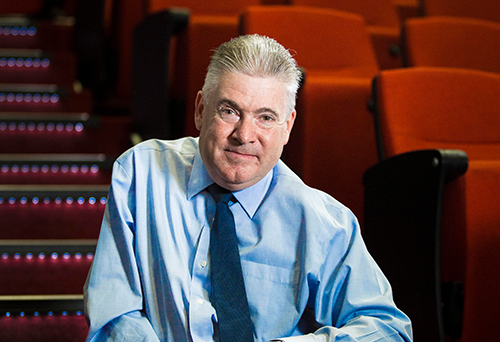
In a career that has traversed three continents, with the intersection of technology and education at its heart, Martin Bean CBE really exemplifies international experience and perspective.
A native Australian, we talk to him as he enters his third year as Vice-Chancellor at RMIT in Melbourne, looking ahead at the country’s continuously evolving higher education system and the opportunities afforded it through greater international and industry partnerships, as well as the eager adoption of technology for learning.
Tell us what led you to become a Vice-Chancellor in the UK and then return to Australia to take up the leadership of another university?
The focus of my working life has always been about the intersection between technology and education and I have been lucky enough to work in this area across three different continents.
My degree is in education, but I began working for IT companies early in my career, looking primarily at how technology can be used in learning. It’s been amazing to see how much has changed in such a short period of time. With the arrival of the internet it was very clear to me that at least one of the game changers had arrived for education.
At its inception the internet was largely about content, but that quickly morphed into a social platform, making it much more powerful for education, and more recently it moved into the early days of personalisation and analytics for learning. My job with Microsoft spanned the primary, secondary and tertiary spectrum and was focused on improving learning outcomes for students everywhere in the world, particularly those who needed it the most. Technology was the common factor; it was opening up quality experiences to so many more people on the planet and it was democratising education.
My work at Microsoft exposed me to open education resources and the application of technology to drive access to almost unlimited content. It was an amazing journey and I was working with some remarkable people. It was with some surprise that The Open University in the UK approached me to be their next Vice-Chancellor. I’d been working with them to explore how technology could power social learning and I soon realised what a wonderful institution it was. It remains one of the great success stories of how to open up education through innovation. Starting in the very early 70s, the OU had embraced every step change in technology and I couldn’t think of a better place to put my strategy into action.
Fast forward to 2012 and the Massive Open Online Course (MOOC) phenomena took hold where some of the best universities in the world began giving away their courses for free; another massive step change in the evolution of access to quality education.
It was at this point that Simon Nelson and I, with the backing of The Open University, started FutureLearn – effectively the UK’s response to the US MOOC phenomena. I’m so proud to see the way Simon and his team have evolved FutureLearn, far exceeding our original ambition. Again, somewhat by surprise, I was invited back to my home town of Melbourne to be considered for the role of Vice-Chancellor at the Royal Melbourne Institute of Technology (RMIT), an institution that is over 130 years old, and deeply committed to opening up education to those who may not have traditionally participated at a tertiary level. What was even more special was that RMIT is a dual sector institution offering Vocational Education or VE (Further Education in the UK) all the way up to PhD level, making RMIT a very powerful institution for the future world of work.
The challenge was fantastic, how could I help a 130-year-old institution, based on traditional learning methodologies, really embrace technological innovation to benefit students, staff, the Institution and the communities they serve? A challenge too good to be true, and I now find myself back in my home city in the beautiful Australian sunshine.
Can you tell us what you learned moving from a leadership role at Microsoft to the Open University? How did this influence your approach to and vision for RMIT?
I was very lucky to have had the opportunity to work at Microsoft, particularly in the role I had. I worked alongside the Foundation and had the opportunity to think about how technology could improve education as a sector. The experience, perspective and skills I developed made the transition to the Open University not as different or as complicated as you might think.
The Open University is all about helping people get access to high quality education at a distance using technology. In many ways, an extension of the work I had undertaken at Microsoft. Obviously, there are very big differences managing people in the United States versus the UK, but that’s one of the things I really enjoy about being a global leader; how you can embrace the different cultures and ways of working and still be successful.
I think one of the biggest challenges moving from a technology firm to a university, no matter how close you are to the education sector, is the shift from being an advisor to being a practitioner. It was no longer theory, best practice, or advice. I had to wake up every day and think deeply about the success of our students. It is something that I thoroughly enjoyed and have gone on to develop even further at my role at RMIT – helping our students get ready for life and work.
Are you able to give us examples of your experience recruiting from outside the higher education into university leadership roles?
I have tried to strike a healthy balance on my Executive Team at RMIT, with some coming from higher education and others from a more commercial world. Ultimately, early on in any conversation with a potential candidate I look at their motivations for wanting to join us. I look for a common ingredient, no matter where they come from – the motivation to join a mission-led organisation. I look for people who truly believe in the power of education and want to wake up every day identifying with an organisation that makes a difference in the world.
If you go looking for that drive and attitude, rather than having conversations around compensation, seniority, or job title you not only can attract brilliant talent, but also ensure they are really comfortable working inside a university. In many ways, it eliminates the concern that they may not fit or be able to make the transition.
A specific area of focus in your previous roles was the enhancement of learning through technology. Thinking about this specifically in relation to higher education, how is technology changing and shaping the future of this sector?
I have always believed that technology impacts industries most at the point of consumption. When you look specifically at higher education there is an excellent opportunity for technology to help transform the way we teach, increase accessibility and improve the overall experience. The rise of MOOCs and third party organisations delivering micro credentials has impacted expectations of students and employers considerably.
More recently, personalisation, machine learning, artificial intelligence, and augmented and virtual reality have contributed to the modularisation of tertiary education. In other words, the packages of learning which we call the degree or the diploma etc. are likely to be further broken down and be much more flexible and increasingly industry aligned in the future.
At RMIT we started investing in online education over 20 years ago and student demand for online learning is soaring. In Australia online education is set to be a $3.3 billion industry by the end 2018, and expected to continue to grow significantly over the next five years.
But it’s not a question of e-Learning versus face-to-face learning. We need to embrace the best that both can offer and ensure we create the best contemporary learning experiences possible. The higher education sector needs to act in a much more agile way and move to be more demand side in our thinking – focus more on students and employers needs rather than what we want to deliver.
“I LOOK FOR PEOPLE WHO TRULY BELIEVE IN THE POWER OF EDUCATION AND WANT TO WAKE UP EVERY DAY IDENTIFYING WITH AN ORGANISATION THAT MAKES A DIFFERENCE IN THE WORLD.”
With your knowledge of both the UK and Australian higher education sectors, what would you highlight as key similarities or differences between the two? Are there lessons that could be learnt and adopted by either to enhance their respective systems overall?
Overwhelmingly I would say there are many more similarities than there are differences between overall systems and approach.
However, there are certain areas that strike me as different. One of the key things I have reflected on since I arrived back in Melbourne is the localised nature of higher education in Australia versus the UK. Students here tend to go to university in their home town, very few leave to go elsewhere and that lowers the overall cost of participating in higher education for students and their families.
I also believe there is a larger appetite in Australia for the development of offshore campuses.
A great example of this are RMIT’s very successful campuses in Vietnam, where we have been since the early 2000s. In Singapore, approximately 1% of the entire population has studied at RMIT over the last 30 years. We have become part of the fabric of the Singapore and Vietnamese HE sector and we very much think and act as a global university.
On the other hand, I believe the UK is leading Australia in their intense focus on the quality of the overall student experience. This began in the UK several years ago with the introduction of the National Student Survey, a spotlight on the overall student experience, and learning and teaching outcomes. I’m delighted to see that we are more focused in that area now and I look forward to being part of the response.
“THERE IS AN EXCELLENT OPPORTUNITY FOR TECHNOLOGY TO HELP TRANSFORM THE WAY WE TEACH, INCREASE ACCESSIBILITY AND IMPROVE THE OVERALL EXPERIENCE.”
How important is the international market for the higher education sector in Australia? What are the key opportunities that you see from internationalisation in the next five to ten years?
The international student population is incredibly important in Australia and to RMIT. One of the great characteristics of the city of Melbourne is that it has always been, and will continue to be, one of the great cultural melting pots of the world. We have a vibrant international cohort and we’re proud of the role those students play in the life of the city and state.
More widely, across the HE sector in Australia, international students allow us to be part of the growth phenomena in the Asia-Pacific region. For a smaller, geographically remote nation like Australia, to be part of this growth through our learning and teaching, and also our research, brings amazing opportunities. We can capitalise on these opportunities to enhance our growth, but also, very importantly, we are tackling some of the challenges which come with growth – whether that be climate change; sustainability; building vibrant and contemporary sustainable cities; or enriching communities through healthier lifestyles etc.
How important do you consider to be the connection between business and commerce and the higher education sector? Should there be a greater transference of skills, knowledge and employees between these two sectors?
RMIT’s strategy has a clear statement to ensure that ‘industry is embedded in everything that we do’. Without a doubt this is one of the biggest challenges for universities like RMIT, but one that we have embraced wholeheartedly.
Industry is demanding different attributes from graduates – they don’t just want academic grades or discipline expertise, they are increasingly looking for what is often described as ‘21st century competencies’. However, the collaboration between industry and universities can’t be just a default position of work placements, it has to be based on everything from instructional design to practice based teaching and real-world research. This approach is reflected in our partnerships with Apple for example, to deliver app development courses based on the tech giant’s Swift curriculum. This demonstrates how our vision and strategy are coming to life.
Delivering these programmes with industry partners provides real and authentic experiences and gives students the experience and credentials they need to supplement their academic programmes.
At RMIT we are unashamedly committed to two key drivers – getting our students ready for life and work and making sure our research has real world impact. It’s a brilliant role being a Vice-Chancellor and I’m so proud to be able to lead RMIT at this amazing and challenging time.
MARTIN BEAN BIOGRAPHY

Martin Bean CBE was appointed as Vice-Chancellor and President of RMIT in January 2015. Prior to this, he held the position of Vice-Chancellor at The Open University – the largest academic institution in the UK and a global leader in the provision of flexible learning.
He previously held executive leadership positions in a number of organisations where he was responsible for integrating technology and learning systems. This includes a role as General Manager of the Microsoft Worldwide Education Products Group. In 2012 Martin launched FutureLearn, which was the first at-scale provider of Massive Open Online Courses (MOOCs) in the UK.
Holding a Bachelor of Education from the University of Technology Sydney (UTS), Martin was awarded an Honorary Doctor of Laws from the University of London in 2013 and he was officially named as a Business Ambassador by the UK Prime Minister in 2014. Martin has won numerous awards in both the US and the UK for his contribution to education, including a Commander of the Order of the British Empire (CBE) award for services to higher education in the 2015 United Kingdom New Year’s Honours list.