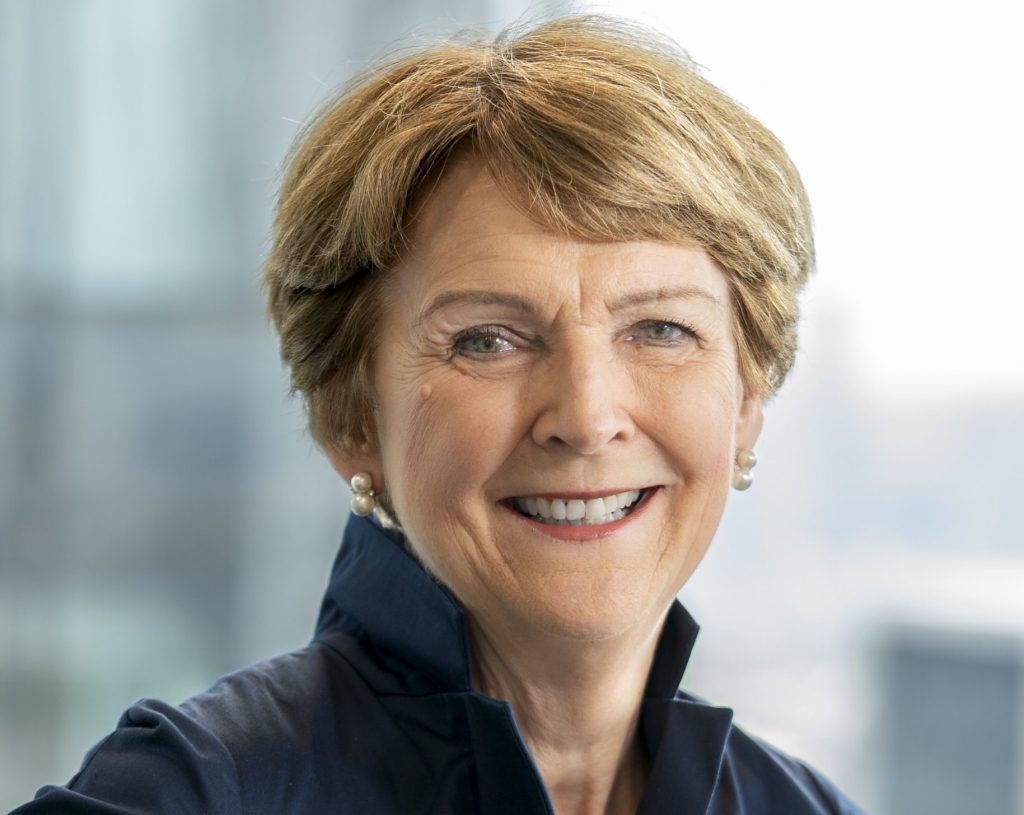
Liz Peace CBE is the Senior Independent Governor on the RICS Council, a key role recommended by Lord Bichard’s review of the organisation’s governance. As a non-surveyor providing independent perspective, she bridges the Governing Council and RICS Board while serving as a conduit for member concerns. Liz is passionate about strengthening governance at RICS and ensuring the organisation fulfills its charter to work for the “public advantage” while meeting the needs of its 142,000 members. She advocates for the real estate profession to embrace horizon scanning, sustainability, and greater diversity as it navigates economic, social and climate challenges.
Your role on the RICS Council, as Senior Independent Governor, was a key recommendation of Lord Bichard’s review of the governance of the organisation. What does this role mean, in practice, and how does it differ from your experience of SID or other non-executive roles elsewhere?
To explain this role, I think it is important to highlight that the board governance structure of RICS is somewhat atypical. We have the Governing Council which represents the membership, and is mostly elected, barring the independent members. This Council sits across both the operating board, known as the RICS Board, and the Standards and Regulation Board (SRB). It is an important distinction to have those two boards as the regulatory aspect must be separate from the professional association. There is also a regional structure to RICS, with a World Regional Board in UK and Ireland, Europe, the Americas, EMEA and APAC. On each regional board, there is a chair and group of members to represent member views. Overall, this is a significant governance structure to manage and communicate with.
In terms of the Senior Independent Governor role, Lord Bichard held this position for a short time himself after his review and I am the first person to come in afterwards. It has been a bit of a learning experience in terms of what works well and how it might be evolved. Lord Bichard always positioned his recommendations as a framework so it makes sense to always be reviewing and seeing how we can improve.
It is a more complex role than being a normal board SID. As Senior Independent Governor I sit on both the Governing Council and the RICS Board to be an independent voice on both and to provide connectivity between them.
The role is also designated as a conduit to members to express their views or concerns about governance. From my perspective, that part is still in development as it is potentially vast.
Strengthening overall governance was an important element of the Review to ensure we don’t face the challenges we did previously, and we are currently working out best how to do this.
“A strong cadre of independent thinkers can help the RICS play a major role in encouraging collective action and the achievement of substantial improvement across that built environment.”
We have also just recruited two additional independent members to join the Governing Council, bringing specific expertise in legal and financial matters from outside the world of surveying.
This external perspective is important. The built environment in the UK is a complex multi-stakeholder sector and there are a lot of people working in it who are not Chartered Surveyors. I am very keen to encourage the RICS to make sure that they are working with these other groups to ensure that collectively we are doing the best possible job in promoting the built environment. We have a huge amount of collective responsibility as a sector from an economic and social, but also increasingly an environmental, perspective, impacting on so many areas of everyone’s lives.
A strong cadre of independent thinkers can help the RICS play a major role in encouraging collective action and the achievement of substantial improvement across that built environment.
Many professional bodies have decided, using often very different governance models, to include non-member as well as member council and/or board roles. At RICS, how do the Independent Governors ensure their voices are heard among a much larger number of elected members?
There are now four independents on the Governing Council – me as Senior Independent Governor and Gurpreet Dehal as Independent Member plus the two recent recruits mentioned above. There are other independent members on the RICS Board, the SRB and various committees. RICS has recognised the benefit of bringing in people who have a different perspective. In some areas that is for a very specialist set of skills or knowledge in, for example, audit or remuneration.
The independent roles on Governing Council are not so different from the independent non-executives on other boards. It is our responsibility to encourage a different perspective. Gurpreet and I have played a part in promoting debate about areas as diverse as: the future role of surveyors in the built environment and wider society; how AI and the growth of Proptech might influence the profession; how the industry can support the wider sustainability agenda beyond the existing government legislation; how the qualifications in the profession are developing and how should they be shaped.
We bring an external perspective from other industries and try to expand the focus if it becomes too inward looking. In my experience the real estate profession tends to be rather transactional and not sufficiently focused on customer service or the post-transactional environment and this is something we need to consider carefully.
It is a very sociable and collegiate profession and sector and that has many positives, but it can result in the same people always talking to each other and that is why having an independent, non-surveyor perspective can be beneficial.
We do need to do more to create an environment of engagement across property and ensure that that chartered surveyors are being used as widely as possible to provide advice and the very specific range of services for which they are trained. They are qualified professionals who operate to a very rigorous set of standards, and we need to make sure the value they can offer is widely understood and their skills put to good use for the benefit of their clients and wider society. You wouldn’t seek medical treatment from someone who wasn’t a qualified doctor or legal advice from a non-lawyer. So, similarly those seeking building and property advice of whatever sort need to understand the best place to obtain it is from a qualified surveyor. But that requires better communication beyond the confines of the profession.
“Remaining current, relevant and at the same time offering a valued service to our members is an ongoing challenge but we have to be able to demonstrate that.”
What do you consider are the benefits of the RICS governance changes, and what challenges remain in embedding those in the longer term?
Lord Bichard was very keen to reaffirm RICS as a body that existed to promote the cause of its members – to make them better qualified, better trained and better educated so that they could serve the needs of their clients and society in the best possible way. RICS had definitely lost its sense of direction – it was clearly not reaching and engaging with members and demonstrating to them the benefits provided by their professional institution. But there were also some significant deficiencies in its governance. Bichard’s review tackled both of those things: to ensure that the organisation would be properly governed and to make sure that it was much better connected with and serving the needs of its membership.
I think it is important to reflect on the actual Charter established in the 19th century which talks about professional surveyors working for the ‘public advantage.’ That is still as important today, to ensure that both commerce and society can rely on a body of chartered professionals who provide informed and trusted advice based on consistent and well-founded standards and supported by an effective regulatory structure.
Since Bichard’s review RICS has become absolutely focused on the membership, which is a substantial 142,000 members. Not surprisingly they tend to want a lot of different things from their Institution. And this means there must be a good understanding around resource and how that can be allocated so that it is providing services that members value and that allow them to maintain the standards of the profession whilst meeting the needs of their clients across the built and rural environments.
We want members to really value being part of RICS because it enables them to keep up to date and know what is needed to serve their clients in the best possible way. Remaining current, relevant and at the same time offering a valued service to our members is an ongoing challenge but we have to be able to demonstrate that – or the members will not consider the Institution to be worth the subscription we ask them to pay.
However, that is not dissimilar to any membership organisation. You can consult and will get different views, and someone must make the decision about what is going to be taken forward. Some will be happy, and some will not, and some will not necessarily respond and continue to be unhappy. That does not mean that we don’t have to consult, we absolutely do, but we need to ensure we are communicating our approach well and articulating why we are making certain decisions, and why we are allocating our resources in a particular way.
The Institution underwent a crisis of member confidence and governance. We have very clearly emerged from that, but the senior leadership is not complacent and understands that there are still improvements to be made to ensure that it is operating effectively, in the interests of our members, and in a manner that allows them to fulfil the public advantage remit.
Bichard’s Review was a brilliant report, but as his changes bed down into practice we will be able to see what is working well and what may need to be amended. That is why he recommended a review every five years – although we will in fact be doing the first one after three to ensure we are on the right track.
RICS’ members belong to a profession at the heart of economic, social and climate change. How is it helping the current and next generation of these professionals ready to face those changes?
RICS is really embracing exactly how it should do that. It recognises the need to be better at scanning the horizon and seeking out the changes and challenges that its members will have to embrace and tackle, which has not always been the case. That is not specific to RICS; in my view the property industry as a whole needs to get rather better at ‘foresight’.
I think the real estate sector has had somewhat of a rude wakeup call with several crises – the global financial crisis, the Covid pandemic, the sustainability agenda, the growth of ‘tech’ and AI and numerous different pressures as a result of rising costs . There was a degree of progress on sustainability, led largely by the construction industry, in the early noughties but when the global financial crisis hit that was sidelined. There are fortunately a large number of people who are now very focused on how the property industry does need to change, but not everybody is, and we need to do more and work a lot harder to get everyone on the same page.
We are seeing new generations coming into the industry who want to have an impact and genuinely make a difference. It is important that RICS addresses that and works with higher education and others to ensure that those young people get the inspiring training that they want to help them to change society in areas such as sustainability and the achievement of the Government’s ambitious housing targets. We need those young people in the profession since whatever the future may bring in terms of AI and other technological developments, I believe there will always be a requirement for the human touch.
RICS has a very active younger membership, and I would like to see how they can play a bigger part in its governance and direction setting. It is also important that we listen to the new entrants to the sector to gain a more diverse perspective. We put a lot of effort into that area, but it is still a challenge to make the built and rural environment world more culturally diverse so we cannot let up on our efforts.
Liz Peace CBE – Biography
Liz Peace was Chief Executive of the British Property Federation, the lobbying organisation for the commercial property industry in the UK, for 13 years until her retirement in 2014. She was awarded a CBE in 2008 for services to the property industry. She currently has a range of non-executive, advisory and charity roles including Chair of Nuclear Waste Services Ltd, Chair of the University of Cambridge Property Board, Senior Independent Governor at the Royal Institution of Chartered Surveyors and NED and Chair of the Sustainability Committee at Howard de Walden Estates Ltd. Her early career was in the Ministry of Defence where she held several roles in finance, operations, management services and defence estates, culminating in eleven years as Director of Public affairs at the Defence Evaluation and Research Agency, where she played a pivotal part in its transformation into QinetiQ plc.