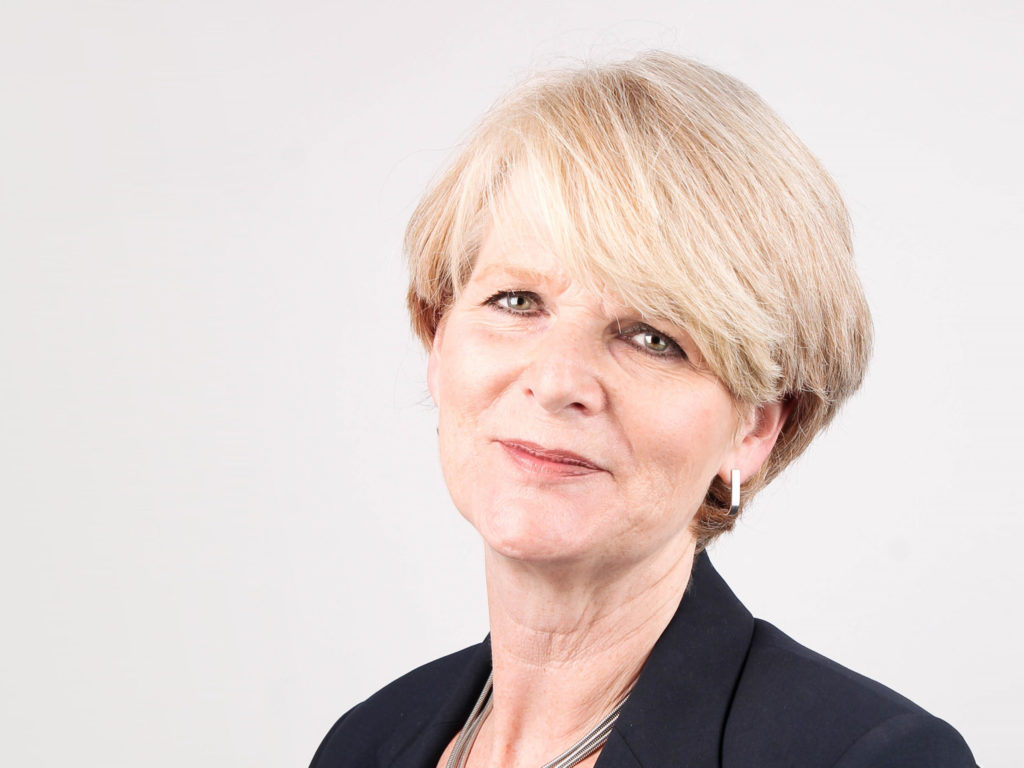
Mary Curnock Cook reflects on her role as Chair of The Dyson Institute, a very different model of Higher Education provision delivering education hand-in-hand with workplace experience. She considers the Institute’s commitment to bridging the skills gap in engineering and explores the equality of the UK’s university admissions system, drawing on her experience as CEO of UCAS.
The Dyson Institute presents a very different approach to Higher Education, with small cohorts of students working three days a week in industry alongside their studies. Can you share a little about the benefits you feel this delivers? Are there drawbacks to this approach?
The Dyson Institute is a very different model to a typical engineering degree in a traditional university. It’s a fantastic opportunity for students to go and have a real job – albeit three days a week – with Dyson itself over a four-year period and also come out with an engineering degree at the end of it. Importantly, the engineering programme is a general engineering programme, and the academic generalism is reinforced by the opportunity for students to rotate across multiple different workplace teams: mechanical, electronics, software and research to note a few. Engineering is increasingly interdisciplinary in nature, requiring professionals who understand electrical, mechanical and software engineering – as well as specialists. The Dyson Institute programme is aligned to that industry need, giving its alumni the skills they need to succeed in a variety of engineering pathways.
Leaving aside how people react to the combination of the study and work model for the moment, one of the main benefits for students is that not only are no student loans required, but they actually get paid for that period. Obviously, they have to pay something towards their accommodation and so on, but I really do think that’s a huge benefit.
We recognise the one thing that’s really different about how the Institute operates is that transitioning from school or sixth form to university is already a big change, but in this case we’re asking them not only to get used to the difference between academic study at degree level compared to school level, but also to get used to working life, and to do that all at once. It’s certainly not for the faint hearted: it’s almost like a double transition challenge for young people and it takes a great deal of commitment to balance working three days a week and then switch into a different mode and pursue your academic learning in the other part of the week. The Institute puts in lots of very personalised support to recognise the challenge for our undergraduates.
It’s quite a demanding programme, but I think the opportunity to see the learning being used in the workplace concurrently with your degree is so valuable. It ticks all the boxes: you’re doing all the academic learning but relating it very directly that same week or term to what is happening in the workplace. This is highly motivating for our undergraduates.
It’s a very different environment to a traditional university, too. Obviously, there is an academic community, although it’s much smaller than that which you would find in the majority of other universities and therefore much more personalised. I think it’s such a fantastic opportunity.
“The opportunity to see the learning being used in the workplace concurrently with your degree is so valuable”

Can you outline the key opportunities and challenges the Dyson Institute has encountered as an alternative Higher Education provider?
When a new provider wants to do something very different, it is a big challenge. You can’t just spin up a new degree programme based on the normal rhythms of a traditional university. The Institute has had to work hard to adapt the programme as it has gone along.
We’ve just recruited our third cohort of students, so we’ve not had anyone graduate from the four-year programme just yet. But because it’s very small – at the moment we’ve got about 120 students – all the undergraduates are known to the team and the Institute more broadly. There are therefore multiple opportunities for both formal and informal feedback: these are students who are known by name, they’re part of the team and the mission for the Institute.
The undergraduates have been really good about giving feedback, and in return the Institute has made changes as we’ve gone along: learning by doing, without compromising the key academic quality that’s so important to deliver. At the moment, academic delivery is managed by Warwick Manufacturing Group, the University of Warwick, so there’s a lot of dialogue between us all.
I suppose any start-up in any sector is going to encounter challenges along the way. For all the planning that you do at the outset, actually running a programme live is always going to be different. As a small organisation with a lot of individuals who are personally committed to making this work, backed up by the Dyson organisation which is also hugely committed to it, the Institute can adapt quickly when things maybe haven’t gone as well as hoped. It has been quick to address things when students have requested a slightly new or different approach: in fact, there’s a completely student-centric focus across the organisation. There are strong processes in place for both formal and informal feedback, and there is a very personal approach to the wellbeing of students. This means that anyone who is finding it tough – whether that’s on the academic side, in the workplace, or with the whole programme put together – the systems are there to pick them up if they are struggling.
“Any start-up in any sector is going to encounter challenges along the way”
Do you think the Dyson Institute’s markedly different approach to other universities manifests itself in a cultural difference when compared with traditional institutions?
When you arrive at the Institute, it’s immediately apparent that it couldn’t be less like a traditional university if it tried! The minute you cross the threshold you’re in a workplace, and one that comes with an iconic brand and a fantastic reputation. But that’s not to say that the academic side isn’t taken absolutely seriously.
Students have a high bar to get admitted in the first place and they are doing their assessments, exams and different projects as they’re going through. I think one of the biggest challenges for students is actually time management: they don’t have the luxury you might have at a traditional university of having down time to pursue their studies because some of that time is being used in the workplace as well.
On admission, you’re doing two things: it’s both a job interview and an academic assessment. Our undergraduates have to show a commitment and aptitude to be able to take on that approach to flexible learning. It takes a bit of getting used to, and I would imagine that at first it’s a bit of a shock to the system, but the undergraduates I’ve spoken to all seem to have figured it out quite quickly and got into a rhythm that works for them.
There are of course, as with any sort of higher education, stress points: whether that’s working up to a big exam or the conclusion of a project, but it seems to work well overall.
The Dyson Institute was founded in an attempt to bridge the skills gap in engineering. Should more be done to encourage take-up of STEM subjects earlier in students’ lives?
I think the general trend is that more young people are including STEM subjects as they’re going through the school curriculum. Obviously, there is a continuing problem that girls seem to be much less likely than boys to take STEM subjects: particularly girls seem to be keener on biology and less keen on subjects like physics, mathematics or chemistry.
The Dyson Institute has actually done really well in terms of managing to get a good balance between male and female students. Over a third of students are female, which is way above the sector average for engineering.
I sometimes feel a bit frustrated with all these initiatives to get more girls into STEM or engineering careers: I’m not always sure they’re really changing the dial all that much. There’s clearly still work to be done, but for me I can’t think of a better place than Dyson and the Dyson Institute to find out what really motivates young women to come into this as a career. At the Dyson Institute, we’ve taken the decision not to require Physics A level as an admission requirement because so many fewer young women take the subject. That helps the gender balance and we provide extra sessions for those that don’t have the Physics background.
I also think it’s an interesting point to note that Dyson as a company is very much design-led as well being an engineering company to its core. People so often forget that engineering is also about product design and that’s something that needs to be emphasised to make sure that engineering as a subject and a career is understood more holistically.
What would you outline as the key international opportunities for the Dyson Institute?
From a general point of view, the Dyson Institute’s primary focus is on becoming really well established in the UK, getting the model working and seeing our first undergraduates actually graduate. It will be so exciting to track what happens with their careers after graduation.
Dyson has of course got a big footprint in Singapore and South East Asia, so there are some opportunities for the Institute there and the problems we’re facing in the UK with developing a pipeline of homegrown engineers isn’t unique to this country! But we’re committed to getting it right in the UK first.
Are different skills required of leaders in privately funded Higher Education institutions?
The key difference here is whether something is for profit or not for profit. The Dyson Institute doesn’t exist to make money for Dyson, it’s there to develop a pipeline of world-leading engineers. That said, traditional universities have a very well-established – sometimes over decades, if not centuries – bureaucracy, and it’s interesting to see how a new provider can take a very different approach to managing the day-to-day business of running a degree programme built around real-time working practice.
We’re also talking about a maximum of around 200 undergraduates at The Dyson Institute, whereas at a traditional university you might be talking about 20 or 30 thousand! That smaller scale makes for a very different culture, where you can take very different approaches.
In the Dyson Institute example, I chair the governing body which has a very clear remit around what it needs to do, especially as we get into the English regulatory system. At the same time, while maintaining the independence of decision-making appropriate to an independent higher education institution, we have to be cognisant of the needs of the Dyson business. It’s a tripartite collaboration between the business, the academic side and the undergraduates. We’re very keen to make sure that the students have a big say in how things are done and what works best for them, but at the same time being very clear that we have to deliver absolutely world-leading academic standards that meet the standards of the engineering profession as well as the needs of Dyson as a business. It’s a very different model, although I don’t think that arises particularly because it’s an alternative provider: it’s to do with scale and the way that the programme has been set up.
My role is certainly different to previous positions I have held, and finding that sweet spot of undertaking my responsibility as Chair of the governing body while at the same time making sure that there’s room for collaboration and cooperation with the business more broadly is really important. In any business you will have stakeholders, and you have to manage those relationships. Whatever it says on paper about who you are and what you do, if you’re not very clear about who your key stakeholders are and what their motivations and drivers are, then you’re probably not going to succeed.
You have previously voiced your concerns about gender equality as studies found that women now significantly outnumber men in almost two-thirds of degree subjects. What measures should HE institutions put in place to ensure truly equal opportunities for all?
The single application process through UCAS that we have in place in the UK is pretty unique in the world and ensures that everybody gets treated equitably. The real problem, I think, is in the pipeline. If you look at educational attainment across the system going right back to early years, through primary and secondary, what you find is that very early on boys start falling behind girls in education. That gap gets bigger and bigger, so that by the time you get to sixth form you have many more girls than boys taking A-Levels, which plays out into many more women applying for Higher Education than men. I don’t think it’s about equity in the admissions process but is more about what’s happening in the education system more broadly.
Should greater steps be taken to ensure that admission systems are without bias?
I would say that this is not about the admission system itself. I worked right at the frontline of university admissions for over seven years, and I never thought that there was a real problem with bias, either conscious or unconscious. For me, it’s all about attainment and the gaps that open up in schools. And that’s not just about boys and girls, it’s about rich and poor, north and south, and different types of schools – for example, coastal and rural schools tending to do much less well than those in urban areas. It’s less about fairness in the admissions system and more to do with broader inequity in the education system. We need to make sure that groups of students who are typically under-represented in higher education are given additional support to do as well as their peers.
“It’s less about fairness in the admissions system and more to do with broader inequity in the education system”
Finally, you are also Chair of Trustees at The Access Project. Can you tell us a bit about the charity and the work it does to help students from disadvantaged backgrounds access Higher Education?
The Access Project is a wonderful charity which has done really well in recent years: we’re now helping 1,500 in over 30 schools in London and now also the East and West Midlands. The mission is to help students from disadvantaged backgrounds get into the top universities, which is where the biggest gap is.
The way that the Access Project is addressing this is two-pronged. One is to make sure that students from those backgrounds have access to extra tutoring. We have volunteer tutors who give one-to-one tutoring in subjects where students need help. This brings double benefits: not only is the student getting tuition in the subject, but they’re also going to see someone in their workplace every week. Particularly for students who might not have previously had the chance to interact with people in professional workplaces, there are a lot of benefits to be had from that exposure.
Secondly, we also have Access Officers whom we place in the schools to work with the students right the way from year 10 to year 13 to help them set their sights on what they want to do at university. We make sure that our students get the right help with choosing subjects and when the time comes to do the UCAS application, so they get the guidance they need. If you think about independent schools, each one in the country will have somebody whose full-time job it is to make sure that their pupils get into the right university. There just isn’t the money and resources to replicate that in most state schools. Obviously, during the virus crisis we’ve had to move all our tutoring and mentoring services online.
We measure the impact of our programme very closely so that we can develop and continually improve it. We’ve been able to compare our students against a ‘synthetic’ control group that UCAS can provide through its data, and we can prove that the impact really is meaningful. You definitely can’t get into university if you don’t apply, so simply getting people to submit an application to a top tier university is often the first hurdle.
Last year we had 13 of our students gain places into Oxford and Cambridge, which was a real high point! The Oxbridge admissions system is seen as one of the most daunting of all: not only do you have to submit your UCAS form, but you may also have to undertake additional tests and of course there is the famous interview. Having the support of someone who knows how to get through what could be a very stressful and unknown process is invaluable. Many of our students might not have access to anyone in their family or community who has been to university, let alone to Oxford or Cambridge, so the additional support is vital.
Mary Curnock-Cook Biography
Mary Curnock Cook is an independent education expert serving in a non-executive capacity on a number of Boards.
From 2010-2017, Mary was Chief Executive of UCAS. Earlier in her career she held executive and non-executive positions in the education, hospitality, food and biotech sectors.
She is a Council member at the Open University, a non-exec Director at the Student Loans Company and the London Interdisciplinary School, and is a Trustee at multi-academy trust, United Learning and Founders4Schools. She Chairs the governing body of the Dyson Institute, and the Access Project which helps students from disadvantaged backgrounds progress to top-tier universities. She is Network Chair for Emerge Education, the leading edtech investor in Europe. She is also on the advisory boards of the Higher Education Policy Institute (HEPI) and Cairneagle Associates.
Mary has an MSc from London Business School and was awarded an OBE in 2000. She is an honorary Fellow of Birkbeck and Goldsmiths and has an honorary doctorate from the University of Gloucestershire.