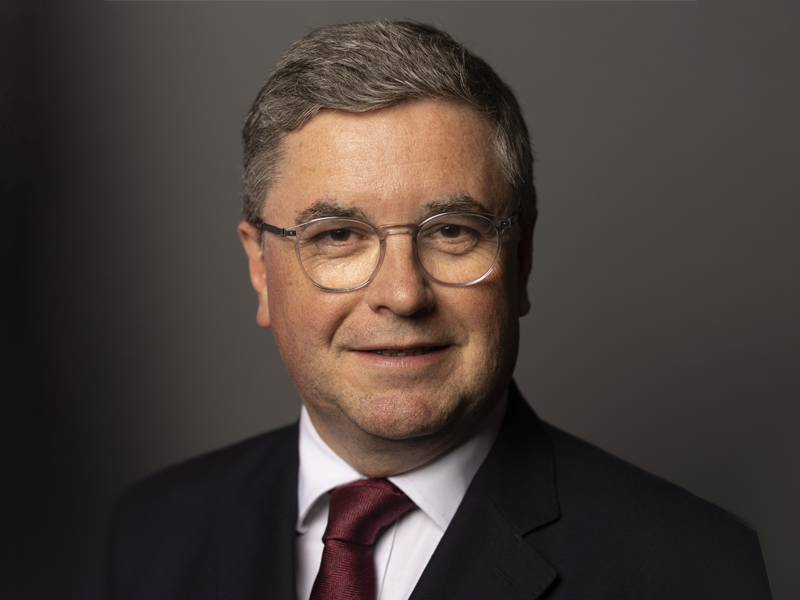
Introduction by Kate Ludlow, CEO and Consultant at Saxton Bampfylde
When shouts of “Resign!” echoed through the Commons, Sir Robert Buckland’s response wasn’t panic, it was satisfaction. “Finally, I’ve made an impression.”
It’s a revealing moment from a politician who defies every modern leadership stereotype. No grandstanding. No tabloid theatre. Just a former barrister who brought courtroom composure to government chaos, navigating pandemic and constitutional crises with what one aide called: “Calm”.
But don’t mistake calm for soft. “I’m not nice,” Buckland says. “I might be kind, considerate, respectful, and compassionate but I’m not nice. Nice implies being anodyne.”
In this conversation with Philip Rodney, Senior Advisor at Saxton Bampfylde, the former Lord Chancellor reveals what it takes to lead when the rulebook gets torn up and your stomach churns while your face stays steady. Welcome to politics as problem-solving, not performance art.
You have held many positions in Government – Solicitor General, Minister of Prisons, Secretary of State for Justice, Lord Chancellor Secretary of State for Wales. During your time as Lord Chancellor, you navigated significant constitutional and political challenges. How do you maintain clear decision-making and team cohesion when leading through periods of intense pressure and uncertainty?
Well, I think the short answer is lead by example. Let’s take COVID, which was the biggest peacetime challenge that any government’s faced since 1945. The preconceptions about how Government and the civil service work were upended in a few days. The old belief that you were there to just steer the strategy and work through the hierarchy—none of that was going to be enough for the immediacy of the challenge we faced in our prisons and courts.
I remember ringing Kenneth Clarke, one of my predecessors, to say, “You were in government for a quarter of a century. What do I do, Ken?” He said, “I never did a pandemic. Just trust your judgment and crack on with it.” So I did.
We had to think imaginatively. I created a flatter structure so we could make decisions much more swiftly, speak to the relevant specialists directly, and then make minuted but quick decisions to respond to the scale of the crisis. We instituted a virtual box system via iPad, because that was the most practical way to deal with decisions quickly.
I believe it’s all about calmness. I once asked one of my principal private secretaries for a word to sum up my presence in the department. He said, “Calm.” I thought, I’ll take that – even though my stomach was often churning inside. If you don’t project an air of calmness, decision-making becomes clouded. You have to set the example.
I used to describe it as happy efficiency—we were all happy, sharing a joke, smiling, enthusiastic, but hard-working. The team would stay well beyond hours, working till seven or eight pm sometimes. But they were happy to do it because they knew it was for a good cause, and the working environment was healthy.
“Sometimes the reaction you get tells you more about your opponents than it does about you. Many of the opponents I’ve built up over the years are people I’m rather glad I don’t agree with.”
As a senior minister, you had to balance legal principles, political realities, and public expectations. What approaches have you found most effective for leading when stakeholders have fundamentally different perspectives and priorities?
First of all, you’ve got to concede the point: you can’t please all the people all the time. There are going to be positions you have to take that upset or disadvantage other people, but you’ve got to be honest about that. You don’t have to be gratuitously insulting or difficult. Even in politics, where conflict and clash are part of the process, you can be firm but polite and fair.
The position of Lord Chancellor is probably the most challenging in many ways. Unlike any other ministerial role, it requires you to take a public oath to defend the rule of law and the judiciary. I was always very confident that everything I did was in fulfilment of that oath. There were moments—prorogation, the UK Internal Markets Bill crisis—where the competing views were very strong and the pressure was very high. You’ve just got to know your own mind and be firm but fair and carry on.
I can remember one day when I was doing Justice Questions in the House of Commons – I think it was on my birthday actually – and as I left the chamber, people were shouting “Resign!” I thought, finally, I’ve made an impression! Sometimes the the reaction you get tells you more about your opponents than it does about you. Many of the opponents I’ve built up over the years are people I’m rather glad I don’t agree with. Roosevelt said, “I rejoice in their hatred.” He was right.
“I’m not nice. I might be kind, considerate, respectful, and compassionate, but I’m not nice. Nice implies being anodyne.”
Your legal background clearly shaped your approach to politics. How did being a lawyer influence your political style and effectiveness?
The law offices are totally different from any other part of government. You have this extraordinary interplay between law and politics, and the role of ministers is very different because you’re not just a politician, you’re a lawyer giving independent advice to government. In some legal decisions about sentencing or the merits of a case, you can’t wear your political hat. It’s one of the most complex roles in government, but I loved doing it for five years.
I built trust by quickly establishing that I was prepared to do the work. I would listen, take advice, challenge, and fulfil that role in the best traditions of the office. I also insisted on doing my own cases—about 40 or 50 in the High Court and Court of Appeal. I think that helped the reputation of the office in the eyes of the legal profession and judiciary.
When I became Lord Chancellor, I think the legal profession was relieved because they knew I understood how the system worked—I didn’t have to be taught or read a manual. Trust takes years to build but is lost very quickly. Donald Rumsfeld once quoted the Dutch proverb, “Trust arrives on horseback but departs on foot,” and he wasn’t wrong. Because I had the confidence of the judiciary, I was stronger politically and able to speak with greater authority in Cabinet as their representative.
“I believe in politics you were there to find solutions, not invent problems.”
As I was thinking ahead of our conversation today, I was wondering whether, for a politician, I wasn’t very political. But I am very political, because knowing how to achieve the outcomes you want—that in itself is being political. If it means sometimes giving credit to somebody else or moderating your approach, then I’m more prepared to do that to get what I think is the right result. I survived longer than most.
Michael Gove said that perhaps I was too nice for politics. I replied, I’m not nice. I might be kind, considerate, respectful, and compassionate, but I’m not nice. Nice implies being anodyne. I never worried about offending people. I wouldn’t have gone into politics as a Conservative in Wales if I worried about that. I’m a lot tougher than people realise.
Our sense of what it means to be political has changed—we think you have to be loud, in the headlines, butting heads. But the subtler art of politics has been lost and forgotten. I’m more than prepared to have an argument about an issue I care about. But when you’re trying to get a policy over the line, you’ve got to use whatever means are available—the subtler arts of persuasion, quieter diplomacy. As a lawyer, you’re a trained negotiator. I believed in politics you were there to find solutions, not invent problems. There’s too much now of “let’s find an issue we can be divided on” because it gets names in lights. I just think that’s lazy.
Read part two of our interview with Sir Robert